Touchless versus friction is the first question every wash buyer asks, and most answers they get are sales pitches wearing lab coats. Here’s the honest comparison: both work, both have failure modes, and your fleet mix decides.

What touchless does best
Touchless systems clean with matched chemistry and high-pressure water — nothing contacts the vehicle. That makes them the specification for wrapped trailers, graphics, mirrors, sensors, and mixed fleets where no single brush setting fits every body. The dependency: chemistry must be right, because there’s no brush to forgive a weak program.
What friction does best
Friction systems physically lift film that chemistry alone leaves, producing the polished, consistent finish high-volume uniform fleets specify. Modern soft-touch filaments with lubricating foam are engineered for commercial paint — the horror stories come from worn brushes and dry running, which are maintenance failures, not concept failures.
The deciding questions
Wraps and sensors in the fleet? Touchless leans in. Uniform tractors chasing showroom shine? Friction leans in. Heavy static grime? Friction lifts it; heavy chemical-responsive film? Touchless with a proper two-step handles it. Many high-volume facilities run both — a hybrid tunnel or separate lanes — and sell the difference as service tiers.
Decide with data
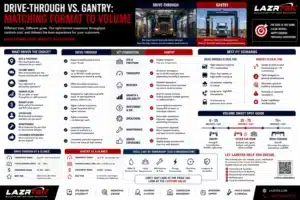
The format decision belongs downstream of demand analysis: what fleets, what soils, what volume. That’s the sequencing a feasibility study enforces — and why the wash systems comparison on our site starts from operations, not equipment brochures.
Go Deeper