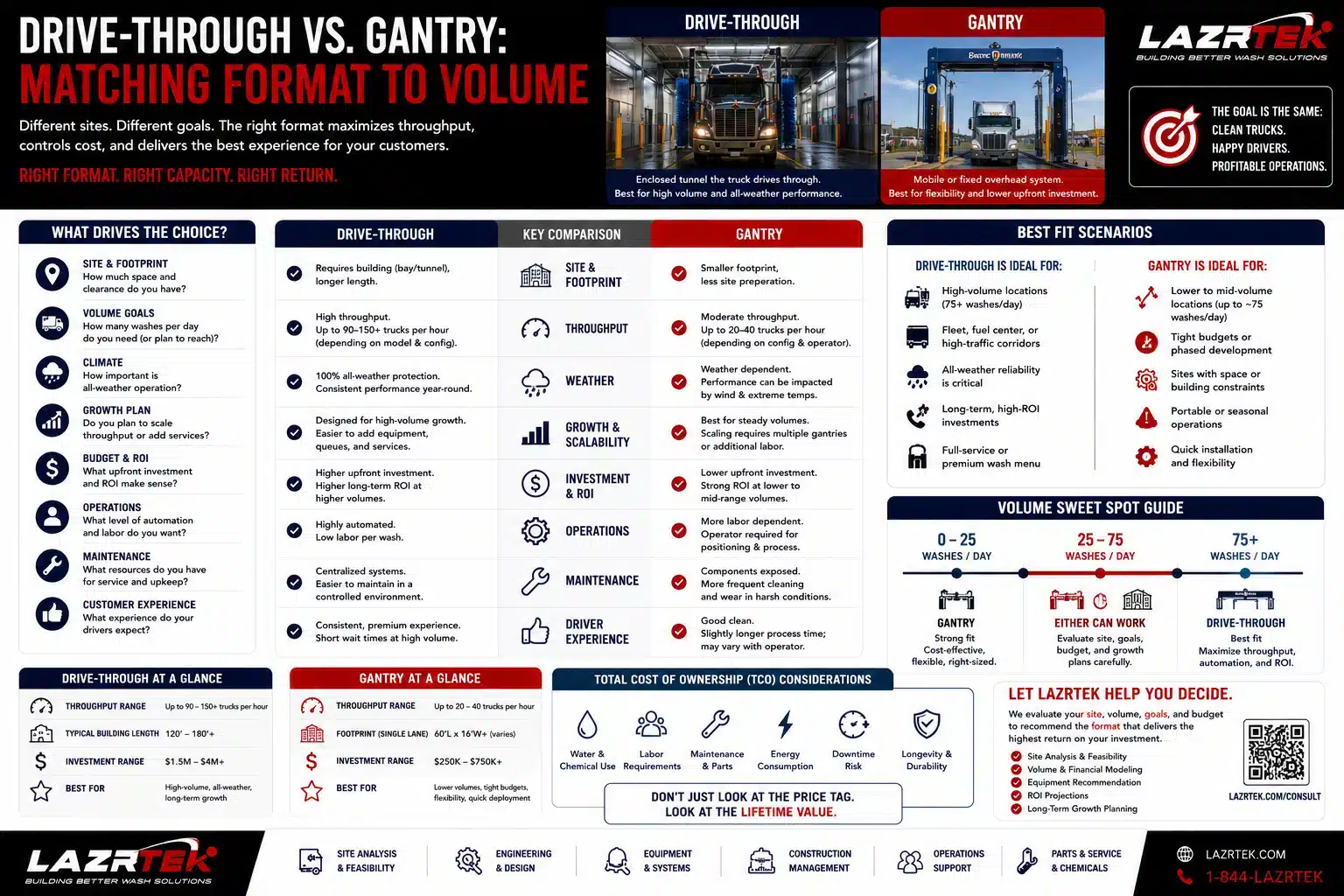
Drive-through or gantry isn’t a quality question — it’s a geometry and volume question. One format moves the truck past fixed equipment; the other moves equipment over a parked truck. Everything else follows from that difference.
The drive-through case
In a drive-through tunnel, the next truck enters before the last one exits — continuous flow, the highest throughput of any format. That’s the retail corridor machine: when a queue forms at peak hours, throughput is revenue, and nothing else clears a queue like a tunnel. The costs: a longer building, more sitework, more capital.
The gantry case
A gantry washes one vehicle per cycle in the smallest building footprint of any automated system — less plumbing, faster installation, lower capital. It’s the depot and district workhorse: scheduled fleets, moderate daily volumes, constrained parcels, budgets that need to pencil conservatively.
The crossover math
The decision is a queue calculation: peak-hour arrivals versus cycle time. When peak demand consistently outruns a gantry’s cycle throughput, wait times push drivers away and the tunnel’s capital earns its keep. Below that line, the tunnel is expensive ambition. Your corridor’s truck counts — the demand work inside a feasibility study — supply the arrival side of that equation.
Format follows demand
Buy the format your volume justifies, not the one the brochure glamorizes. The systems comparison maps formats to operation types for exactly this reason.
Before comparing machines, separate market demand, service menu, cleaning method, and vehicle movement in the truck wash service mix and equipment guide.