Published for LazrTek — April 2026
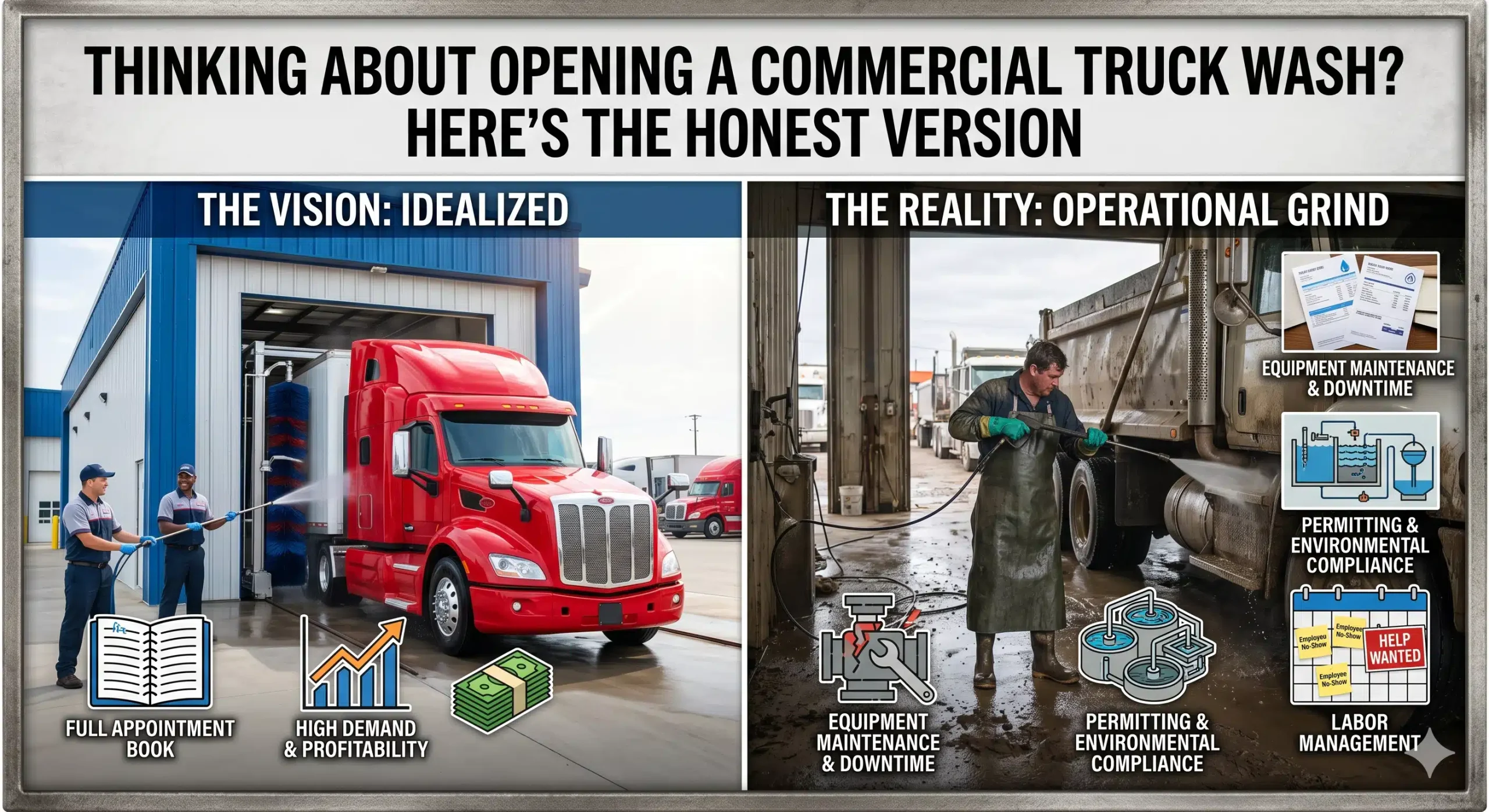
Every few months somebody calls our office and says some version of the same thing: “I’ve got a little land, I’ve got some capital, and I keep hearing truck washing is a great business. Is it?”
Short answer: it can be. Genuinely.
Longer answer: it depends on a bunch of stuff nobody tells you up front, and the people pitching it the hardest usually skip the boring parts. So let’s walk through the honest version — what the commercial truck wash business actually looks like in 2026, what it costs, what it pays, and where the pitfalls hide.
This isn’t a pitch. If after reading this you decide truck washing isn’t for you, great — you saved yourself a lot of money and sleepless nights. If you decide it is for you, at least you’ll go in with your eyes open.
Why truck washing keeps coming up in investment conversations
There’s a reason this keeps landing on investor radars. A few, actually.
The U.S. commercial vehicle fleet is massive and growing. The global commercial vehicle fleet is projected to exceed 380 million units by the end of 2026. And every one of those vehicles needs to be cleaned — regularly, professionally, and in a way that complies with an increasingly strict set of environmental rules.
Unlike passenger car washing, which lives and dies by weekend weather and consumer impulse, commercial truck washing is B2B. Contracts. Recurring revenue. Fleet managers who need their trucks washed every week whether it rained or not, because DOT inspectors don’t care if it’s been a slow month.
Superior Wash — one of the bigger mobile players — openly describes commercial fleet washing as “recession-proof” and has been in the space for over 35 years. Fleet Clean USA, another franchised mobile operator, reported revenues of $619,000 per unit with a strong payback ratio driven by low overhead.
Here’s what’s interesting: the car wash industry overall pulled in roughly $20.7 billion in U.S. revenue in 2025 with operating margins in the 14–15% range. And within that, commercial truck and fleet washing is the less-crowded, less-picked-over niche. Most of the franchise hype and private-equity money has been chasing express passenger car tunnels. Commercial fleet wash has been flying a little under the radar.
Which is exactly why it’s worth a look.
The four models you can actually pick from
Before we get into numbers, you need to know there isn’t one “truck wash business.” There are at least four distinct ones, and they have wildly different economics.
1. Mobile fleet washing. You and a rig drive to the customer’s yard, wash trucks on-site, leave. Lowest barrier to entry — franchise total investments in the $70,000 to $150,000 range are common. No real estate. No permitting nightmares. The downside: you’re selling your time, your margins get squeezed once you hire drivers, and your growth is capped by how many rigs you can afford to operate. Good for getting started, harder to scale past a certain point.
2. Fixed-site drive-through truck wash. A dedicated facility — bay, tunnel, water reclamation, drainage, the whole thing — that trucks drive through. This is where the real revenue lives. Throughput is far higher than mobile, margins are better once you hit volume, and you can build long-term fleet contracts that basically print money. It’s also a much bigger capital lift.
3. Gantry/rollover wash. Instead of the truck moving through a tunnel, the washing equipment moves over the stationary truck. Smaller footprint, less plumbing, faster to build. Good for lower-volume sites, depot installations, or locations where land is tight. See gantry wash systems for the different configurations.
4. Specialty washout. Trailer interior washouts, food-grade sanitation, tanker cleaning — narrower market but higher per-ticket prices and less competition. Automated trailer washout systems are seeing serious demand from food and pharmaceutical carriers dealing with FSMA compliance.
Most successful operators I’ve seen aren’t religious about one model — they pick the one that matches their capital, location, and appetite for operational complexity. A lot of them start with a single drive-through and add specialty services over time.
What does it actually cost?
Here’s where people’s eyes glaze over, so I’ll keep it concrete.
Mobile fleet washing: $70K–$150K total investment for a franchised operation; a little less if you go independent, but you give up the head-start of corporate sales support. You can be operational in 30–60 days.
Fixed-site truck wash facility: This is where the range gets wide. Land, site prep, building, equipment, water reclamation, permits — you’re looking at anywhere from $800K on the low end for a modest gantry-rollover setup to $3M+ for a full automated drive-through tunnel in a high-cost market. Passenger car wash investors report ROI typically landing in the 20–35% annual range, and commercial truck wash can run at the higher end of that when the site is well-placed and well-operated.
Equipment alone — the actual wash system, without land or building — varies a lot depending on what you’re buying. A touchless drive-through with proper water reclamation is fundamentally a different price point than a basic rollover. If you want a real quote for your situation, LazrTek offers a free custom quote and a consulting service specifically for people evaluating whether to build.
The biggest single variable is always land. You can’t reclaim water that drains into a storm sewer, and you can’t legally operate without proper containment. Land with existing commercial sewer access, proper zoning, and truck-friendly ingress/egress is worth paying extra for. Cheap land that requires expensive site work usually isn’t actually cheap.
Where the money actually comes from
Let’s talk revenue for a second, because this is where a lot of first-time operators get surprised.
A well-run commercial truck wash doesn’t really make its money on walk-in traffic. It makes its money on recurring fleet contracts. A single regional logistics company with 80 trucks that all need to be washed weekly is worth more to you than a hundred random owner-operators passing through.
The good contracts look something like: weekly or twice-weekly service, $35–$75 per truck depending on wash type and regional pricing, 12- or 24-month contract terms, auto-invoiced at month-end, and typically zero seasonal variation.
Stack three or four of those, and you’ve built a business that throws off predictable cash every month regardless of what the weather’s doing or what consumers are feeling about the economy.
The shift to subscription and recurring-revenue models is the single biggest reason investors are still interested in the broader wash sector — membership revenue grew about 10% year-over-year in 2025, with churn stabilizing around 7–8%. On the commercial side, the equivalent is the fleet service contract, and it’s more durable than consumer memberships because the customer is a business that literally cannot operate with dirty trucks.
You do still need walk-in and owner-operator traffic to fill in throughput between scheduled fleet blocks. But fleets are the engine.
What separates successful operators from failed ones
I’ve watched enough of these go well and poorly to have some opinions. Four things seem to matter the most.
Location, location, throughput. Not just traffic count — proximity to trucking corridors, distribution centers, and major fleet depots. A mediocre facility next to a major FedEx hub will outperform a beautiful facility ten minutes off the corridor. Look at where the trucks already are.
Equipment you don’t have to apologize for. This one’s boring but decisive. A cheap wash system that breaks down every other week destroys your fleet relationships faster than anything else. Fleet customers plan around your service. The moment you can’t deliver, they start calling your competitor. LazrTek’s piece on how to choose a truck wash manufacturer that delivers real results gets into this, and it matters enormously.
Water reclamation from day one. Skipping this is the single most common mistake new operators make, and it ends the same way every time — a compliance incident, a stop-work order, and a scramble to retrofit. The EPA regulates commercial vehicle wash discharge through the NPDES Multi-Sector General Permit, the 2026 update is in progress, and state-level enforcement has been getting more serious every year. Build it in up front. It pays for itself on water savings alone within a few years, and it keeps you out of regulatory trouble permanently.
Customer acquisition discipline. Sales is not a background activity. The operators who grow consistently treat fleet account acquisition like a real sales job — calling fleet managers, offering trial services, handling billing cleanly, showing up on time. Franchised systems handle some of this for you, which is a big part of the reason the franchise fee isn’t crazy. Independent operators have to build it themselves.
The equipment question: what are you actually buying?
If you do pull the trigger, here’s what a real commercial truck wash facility needs to have, roughly in order of importance.
Core wash technology. You’re picking between brush-based systems, touchless, hybrid brush/touchless, and gantry rollover. Each has a different use case. Most high-volume operators end up with drive-through configurations — see the best truck wash systems for high-volume facilities for how to match throughput needs to equipment.
3D vehicle profiling. In 2026, this is basically table stakes. Modern systems scan each truck and customize the wash cycle, which means you can wash a cabover day cab and a long-hood sleeper back-to-back without reprogramming anything. See 3D profiling gantry configurations for the different options.
Dedicated wheel and undercarriage. If you’re anywhere near the salt belt — or planning to — a wheel and undercarriage wash is a meaningful revenue add-on and a major service differentiator. Corrosion-conscious fleets will pay a premium for this.
Water reclamation. Not optional. As discussed.
Proper chemistry. A wash facility is only as good as its detergents. LazrTek’s detergent lineup covers the full range — debugger, heavy foam, pre-soak, pH-balanced foams, salt protectants, degreasers. The right chemistry keeps your equipment happy, your results consistent, and your reclamation system functioning.
Trailer washout capability. Optional, but a massive revenue add-on if you’re anywhere near food-grade or pharmaceutical carriers. Automated trailer washout pricing is significantly higher per cycle than exterior washing and the competition is thinner.
Control and telemetry. Modern systems log everything — water use, chemical dosing, cycle times, equipment health. That data is gold for both operational optimization and documenting compliance to auditors.
A realistic first-year
Not going to pretend to predict your specific numbers, but here’s roughly how a decent first year unfolds for a fixed-site operator who did the prep work.
Months 1–3: Facility opens. Low volume, mostly walk-ins and owner-operators. You’re burning cash and questioning your life choices. This is normal.
Months 3–6: First fleet contract signs. Then another one. Revenue becomes predictable enough to plan around. You start to see how the economics will actually work.
Months 6–12: Fleet contracts stack. Word of mouth kicks in — fleet managers talk to each other, and if you’re doing a good job, you’ll be hearing from their friends. Throughput climbs. Water and chemistry costs start to look very reasonable per truck. You start thinking about whether to add a second location.
The operators who fail usually fail in months 1–6, because they either underestimated the capital needed to get to cash-flow-positive or they cheaped out on equipment that breaks and costs them their first few fleet relationships.
Resources worth reading before you commit
If you’re seriously evaluating this, these are worth your time:
- International Carwash Association (ICA) — the industry’s trade association, good data on market trends and operational benchmarks
- American Trucking Associations (ATA) — understand your customer base
- EPA NPDES Stormwater Program — what you’re legally on the hook for
- EPA WaterSense Commercial Washing Resources — water efficiency benchmarks and incentive programs
- SBA 7(a) and 504 loan programs — the most common financing path for car wash builds
- Transport Topics — trucking industry news; helps you understand fleet customer economics
- Heavy Duty Trucking — same
- Rinsed Car Wash Industry Report — quarterly data on membership and subscription trends in the broader wash industry
Also worth reading from LazrTek’s own library: why a US truck wash manufacturer matters for your fleet, the best school bus wash systems (a specialty niche that overlaps with truck wash operations in interesting ways), and the full projects portfolio showing real facility builds.
The honest summary
Commercial truck washing is a real business with real returns. It’s not a get-rich-quick scheme, and anybody pitching it that way should make you suspicious. But it’s got something a lot of small businesses don’t: recurring B2B revenue, a growing customer base, and a structural undersupply of professional operators in most markets.
The people who make it work share a few things. They take the water compliance stuff seriously from day one. They buy equipment that won’t strand them at 5 AM when a fleet customer shows up. They treat fleet account sales as a real discipline, not an afterthought. And they’re patient through the first six months, which is when a lot of the wobbly operators quit.
If that describes you — patient, operationally minded, willing to do the unglamorous work — this is a business that can pay off handsomely. If you’re looking for passive income that runs itself, it’s not. Nothing worth doing in this industry is actually passive.
Thinking about building a truck wash facility — or trying to figure out whether your current site could support one? Book a free consultation with LazrTek or call 1-844-LAZRTEK (1-844-529-7835). We’ve helped enough operators plan, build, and optimize commercial truck wash facilities to have some opinions about what works. We’ll walk your site, run the numbers honestly, and tell you what makes sense for your situation — even if sometimes the honest answer is “wait and build something better later.”
More from LazrTek: Wash System Types · Vehicle Types We Service · Detergents · Consulting · Projects · Blog