Published for LazrTek — April 2026
I was in a fleet yard outside Fort Worth a few weeks ago, and the yard manager pointed at a row of brand-new Freightliner eCascadias and said, half-joking: “Nobody gave us a manual for washing these things.”
He wasn’t wrong. And he’s not alone.
There are now more than 4.2 million commercial EVs on North American roads, with the big Fortune 500 logistics outfits committing to 40–60% fleet electrification by 2030. Every one of those trucks needs to get washed. And nobody — not the OEMs, not the trucking schools, not the wash equipment folks until recently — has really sat down and spelled out what’s different.
So let’s do that. No marketing fluff. Just the stuff you actually need to know before you send a $300,000 electric tractor through the same wash cycle you’ve been using on your old diesel day cabs.
First — relax. You can wash them.
Every time this topic comes up, somebody in the room has heard a rumor that you can’t pressure-wash EVs. That they’ll catch fire. That the battery will short out. Whatever.
It’s nonsense.
Modern commercial EVs are built to IP67 or IP69K ingress-protection standards, which is engineer-speak for “sealed tight enough to take dust and pressurized water without flinching.” Volvo explains pretty clearly that their electric truck battery packs sit in a weather-proof enclosure that’s literally integrated into the steel crash structure of the chassis. It’s designed to survive road salt, debris, flooded pavement, and yes, your wash bay.
So the truck is fine. The wash is fine. What’s not fine is using the exact same process you used on your diesels and assuming everything will work out. Because there are three very specific places where EVs will bite you if you’re not paying attention.
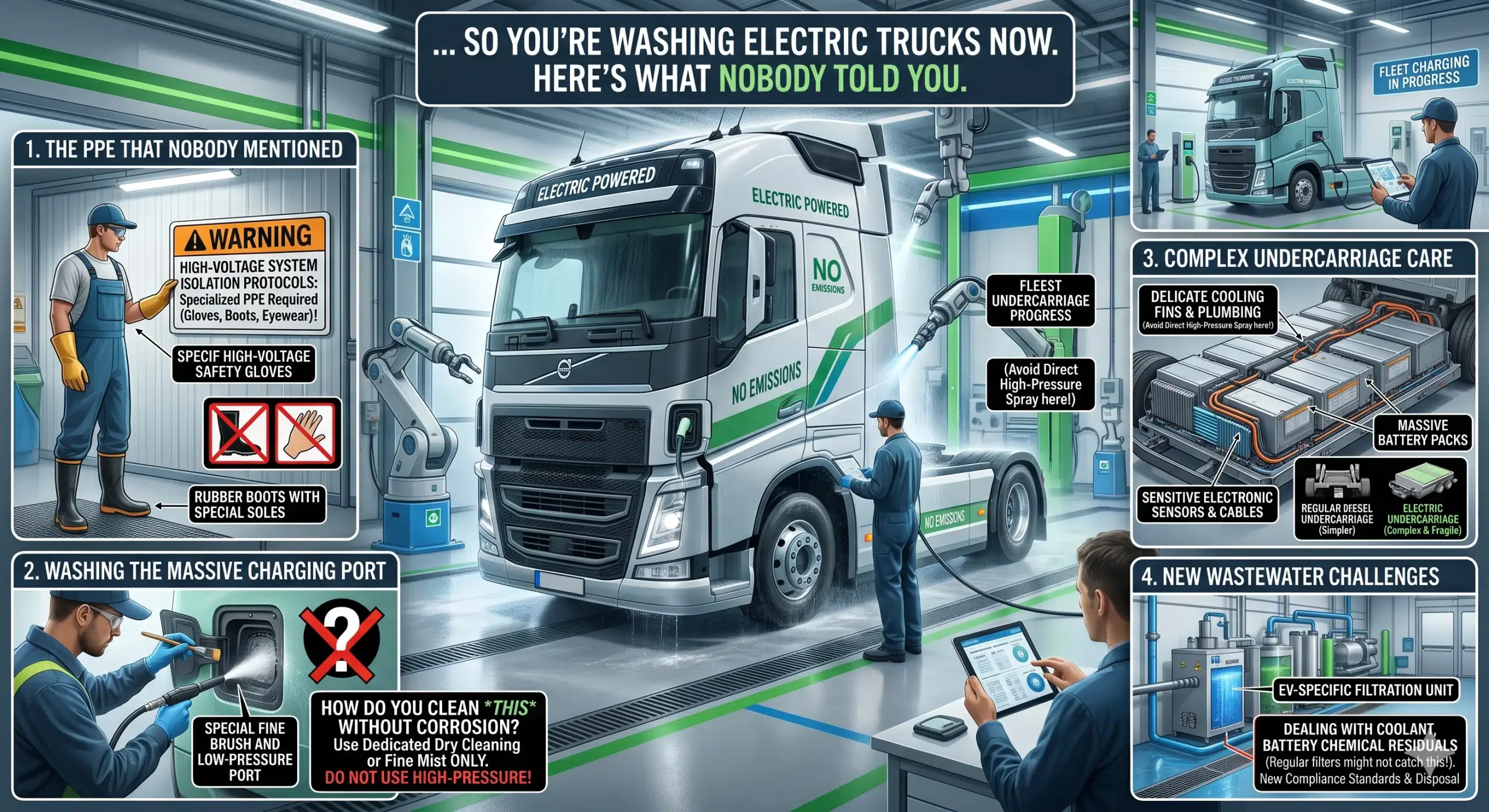
Vulnerability #1: the charge port
This is the one that gets people.
Every EV has at least one charge inlet — the AC port (J1772 or CCS) and usually a DC fast-charge port too. These things are basically a fancy electrical outlet bolted to the side of your truck. They’ve got precision pins, retention clips, and a rubber seal around the door.
That seal is the whole ballgame.
There’s a fleet maintenance checklist from Oxmaint that flags this exact problem: a deteriorated charge port seal lets moisture creep in during washing, and the next time you try to plug in, you get a Charging System Fault code. The truck’s fine. The battery’s fine. But the thing won’t accept a charge, which means it’s not going anywhere tomorrow morning.
I’ve watched fleets learn this one the hard way. Truck goes through the wash Thursday night, won’t charge Friday morning, dispatch is scrambling, three phone calls later the OEM finally figures out there’s moisture in the charge port — and now you’ve got a really uncomfortable conversation about whether warranty covers it.
The way around it is boring and mechanical: don’t direct high-pressure spray straight at the charge port. Easy to say. Impossible to enforce if you’re using a handheld pressure washer at 2 AM. Doable — actually, automatic — if you’re using a 3D profiling gantry that maps the vehicle before the cycle starts and can dial back pressure around sensitive zones.
This is also a pretty good argument, honestly, for touchless systems over brush systems for EV-heavy fleets. More on that in a minute.
Vulnerability #2: the wrong detergent will eat your seals alive
Here’s something that took the industry a minute to figure out.
For years, heavy-truck wash programs have leaned on high-pH alkaline detergents. Makes sense — diesel trucks come in coated with a lovely cocktail of road film, exhaust soot, DEF residue, and oil mist, and alkaline chemistry cuts through all of it.
EVs don’t produce any of that. No soot. No DEF. No oil mist. What they do have is a bunch of polymer seals around high-voltage components, aluminum battery enclosures, and coolant fittings that really, really don’t enjoy being repeatedly blasted with aggressive alkaline cleaner.
So the fix is to shift your chemistry. You want low-pH or neutral-pH foam, and for anything with aluminum panels, metal-safe formulations. In the winter, when you still need to flush road salt off everything, follow up with a salt protectant instead of going nuclear on the primary wash.
You don’t lose cleaning power. You just stop slowly degrading the seals that are keeping water out of the places water shouldn’t go.
Vulnerability #3: the brakes. Yeah, really.
This one’s counterintuitive.
EV brakes last forever. Seriously — brake pads commonly go 100,000+ miles on EVs because regenerative braking does most of the work. The friction brakes barely see action.
Which sounds great. Until you realize brakes that never get used… rust.
The caliper slides dry out. The rotors develop corrosion on the unused parts of the braking surface. And according to the maintenance data, a seized slide on an EV can continuously knock 3–8% off your range — which, if you’re running tight routes, is the difference between making it back to the yard and calling for a tow.
The only real defense is flushing the crud off regularly. A dedicated wheel and undercarriage wash that actually hits the rotors isn’t a luxury for EV fleets running anywhere near the salt belt — it’s preventative maintenance you can measure in dollars per truck per year. Maybe the single highest-ROI wash-bay upgrade for EV operations.
Here’s the opportunity most fleets are missing
Okay, switching gears for a second. Everything above is defensive — stuff you need to do to avoid breaking your EVs. But there’s a real offensive opportunity here too.
Your electric trucks are, let’s be honest, your PR fleet.
The mayor shows up for a photo op next to the electric garbage truck, not the 2018 Mack. The regional news interviews the driver of the electric delivery van. Your sustainability report has a Class 8 battery-electric tractor on the cover, not the aging day cab that hauls paper towels.
Which means appearance matters differently. Brush marks, swirl scratches, paint haze — all the stuff that happens when old-school friction wash meets the soft modern clearcoats and matte wraps these OEMs are using — those are now brand problems, not just cosmetic ones.
This is exactly where touchless 3D profiling gantry systems earn their keep. High-pressure water plus smart chemistry, zero contact. No scratches on the clearcoat. No pressure on the charge port door. And they work just as well on an E-Transit as they do on an eCascadia because the system scans each vehicle and adjusts.
For mixed fleets — and let’s be real, basically everyone is running mixed fleets for at least the next decade — hybrid brush/touchless configurations let you get aggressive on a filthy diesel and gentle on an EV without needing two separate bays.
Don’t forget: the trailer isn’t electric
Quick reality check that a surprising number of fleet planners miss.
Your tractor might be a battery-electric Freightliner. The reefer hooked up behind it is still a regular trailer. Same FSMA food-safety rules. Same cross-contamination risks. Same grime.
Automated trailer washout systems handle the interior hygiene piece with documented cycle records an auditor will actually accept. The tractor can go through EV-appropriate wash while the trailer runs through a conventional interior washout. Same facility, different processes, one workflow.
The tricky part is facility planning. If you’re upgrading for a mixed fleet, you need to think about throughput across all of it. LazrTek’s breakdown of how many trucks an automated system can wash per hour is worth a read if you’re trying to figure out whether your current bay is going to become a bottleneck.
If you’re spec’ing wash equipment this year, here’s what to look for
Let’s keep this practical. Going EV-heavy over the next 36 months? These are the things I’d make non-negotiable:
Variable pressure zones. Not just a high/low switch. You want a system that actually knows where the charge ports, lidar sensors, camera mirrors, and exposed HV cable runs are on each vehicle, and adjusts accordingly. 3D vehicle profiling is basically table stakes.
Touchless or hybrid. Pure brush will eventually mar the clearcoat on newer EVs and can catch on the fragile aero components these trucks use to squeeze out extra range. Touchless drive-through or brush-touchless hybrid gives you flexibility.
EV-appropriate chemistry. Low-pH, neutral-pH, metal-safe formulations. LazrTek’s detergent lineup covers the full range, but the point is: don’t assume your existing chemistry cabinet is going to transfer over cleanly.
Undercarriage wash, seriously. For EV fleets, a proper wheel and undercarriage station might be the single best anti-corrosion investment you can make. The brakes will thank you. Your range numbers will thank you.
Data integration. EVs generate a ton of telemetry. Your wash system should be able to log what it did and hand that data off to your maintenance software so you can correlate wash frequency with brake condition, charge-port faults, and corrosion trends over time.
Facility containment. If you’re charging EVs overnight in the same yard you’re washing in during the day, your water containment and reclamation setup has to be airtight — both for NPDES stormwater compliance and because a runoff event near ground-mounted charging infrastructure is a really, really bad day.
“But what about fire risk?”
Every time. Always comes up.
Short answer: water doesn’t cause EV battery fires. Full stop.
The battery packs are sealed. The battery management system monitors temperature continuously. Thermal runaway is a scenario involving internal cell damage, not a concern about getting the outside of the truck wet. Driving your EV through a rainstorm is no different from running it through an automated wash.
The one real caveat — and this is true for any vehicle, not just EVs — is that you don’t want to run a damaged truck through automated wash equipment. If there’s visible battery pack damage, an active high-voltage fault code, coolant leaking, or evidence of a collision, that truck needs to see a technician before it sees a wash bay. Pretty basic pre-wash inspection stuff. But worth being explicit about.
Zooming out
Here’s the thing I keep coming back to: the EV transition is forcing fleet operators to upgrade their wash facilities whether they were planning to or not. And the equipment that makes sense for EVs — 3D profiling, touchless capability, smart chemistry dosing, proper water reclamation — happens to be the same equipment that dramatically improves economics on your diesel side.
Modern automated systems use less than 75 gallons per truck wash, according to the Department of Energy, versus hundreds of gallons in manual operations. EPA’s WaterSense program shows facilities with reclamation hitting 51% recycled water on average. These numbers move real dollars, especially with water rates climbing in pretty much every market.
In other words: the investment you’d be making anyway to run a competitive operation happens to also be the right investment for going electric. The timing’s actually pretty nice if you squint at it right.
If you’re trying to figure out what to buy from whom, LazrTek’s article on choosing a truck wash manufacturer that delivers real results is a decent starting point, and why a US truck wash manufacturer matters for your fleet gets into parts availability and engineering support — both of which become a lot more important when something at your depot breaks at 4 AM.
Places worth reading if you want to go deeper
Quick list of outside resources I trust on this stuff:
- Heavy Duty Trucking (Trucking Info) — best ongoing EV fleet reporting
- NACFE — independent, no-nonsense analysis of real-world EV truck performance
- ATA Technology & Maintenance Council — where the actual maintenance standards get written
- DOE Alternative Fuels Data Center — adoption data, infrastructure maps
- SAE International — charging standards and safety specs
- CALSTART — clean transportation nonprofit tracking commercial EV deployment
Bottom line
Electric trucks aren’t going away. They’re multiplying. And the fleets handling this well are the ones who figured out early that “washing the fleet” became a more nuanced job the minute the first eCascadia showed up in the yard.
Get the equipment right, get the chemistry right, put a real undercarriage wash in the rotation, and you’ll protect a very expensive asset while making it look like the sustainability-poster-child it’s supposed to be.
Get it wrong, and you’ll learn — probably around month four — that a charge port full of moisture is a very expensive way to figure out your wash process needed an update.
Thinking about what your wash bay needs to look like in five years? That’s actually the right question to be asking. Grab a free consultation with LazrTek or call 1-844-LAZRTEK (1-844-529-7835). We’ll walk your site, look at your fleet mix, think through what’s coming, and spec something that holds up — for your diesels, your EVs, and whatever else shows up next.
More reading: Wash System Types · Vehicle Types We Service · Detergents · Consulting · Blog