Published for LazrTek — April 2026
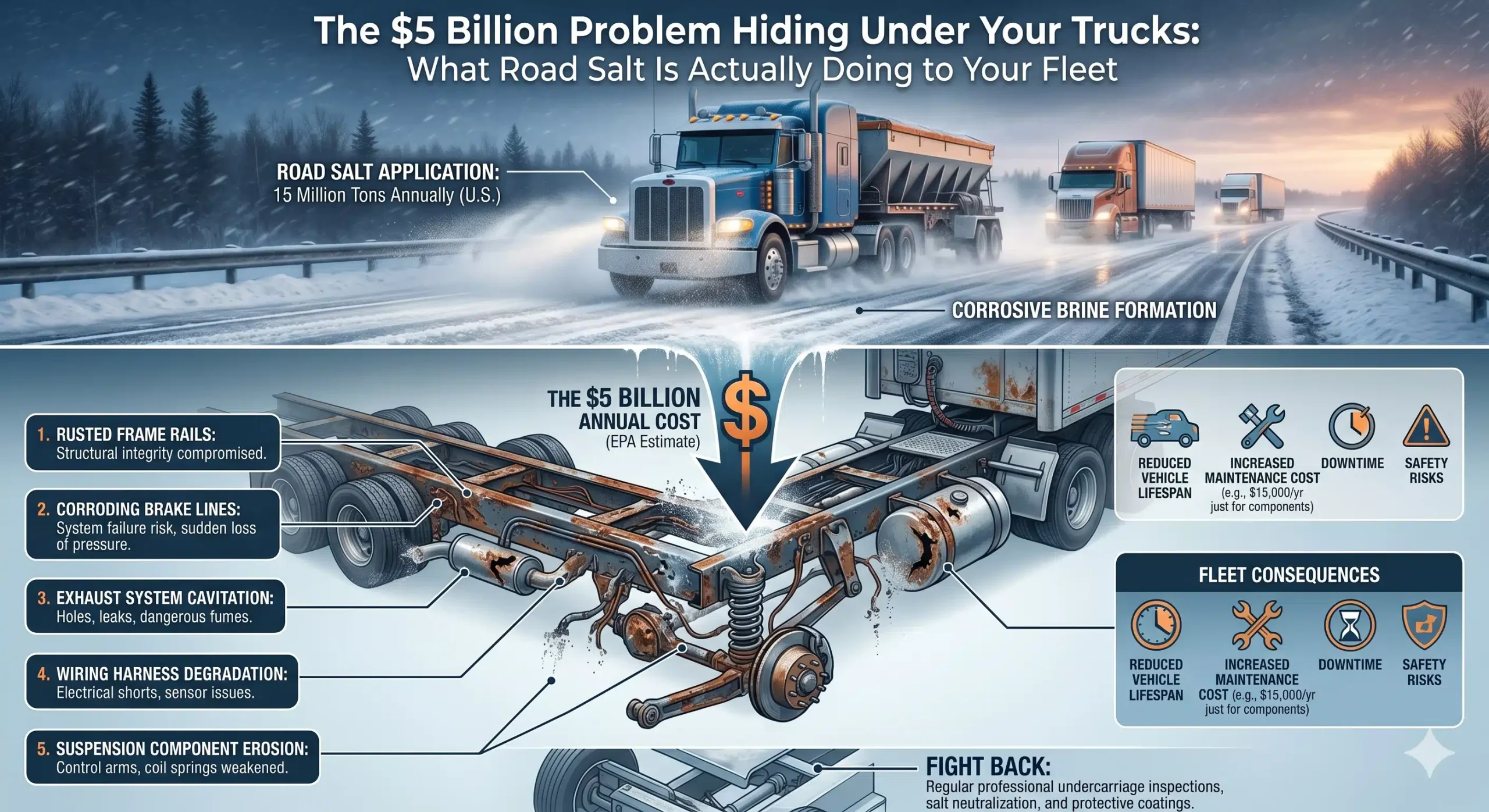
Here’s a number that’ll stop you: the EPA estimates road salt causes roughly $5 billion in annual damage to cars, trucks, bridges, and roads in the U.S. A separate study out of Utah put the nationwide salt corrosion tab between $16 and $19 billion a year.
Read that twice. That’s not roads. That’s not bridges. That includes the damage to your trucks.
And here’s the thing about April — the month we’re sitting in right now. Winter’s over. The salt on the roads is mostly gone. Your drivers have stopped complaining about the cold. And every single truck in your salt-belt fleet is quietly getting eaten from the bottom up, right now, while nobody’s looking.
This is the post-winter window where smart fleet managers get ahead of the damage and cheap fleet managers pay for it in August when the brake line finally lets go on I-80 in Pennsylvania.
Let’s talk about what’s actually happening to your trucks, how much it’s costing you, and what you can actually do about it.
What road salt is doing down there
Here’s the basic chemistry, minus the boring parts. Road salt (sodium chloride, mostly) mixes with moisture — melting snow, highway slush, tire spray — and becomes a corrosive brine. That brine clings to metal. It doesn’t just sit there and dry harmlessly. It keeps working. For weeks.
Chloride ions are especially aggressive with ferrous metals because chlorine bonds easily with iron. What you get is accelerated oxidation — rust, basically — but faster and deeper than normal atmospheric rust. It chews through:
- Brake lines and fittings
- Air system components
- Suspension mounts and bushings
- Frame rails
- Electrical grounds and wiring harnesses
- Fuel and DEF tank straps
- Trailer air lines and connectors
A study of bodywork corrosion cited on Wikipedia’s road salt entry found that vehicles on salted roads had 50% more cosmetic corrosion damage than vehicles on unsalted roads. And the cosmetic stuff is the part you can see. The structural stuff underneath is worse.
How bad does it get? A real example.
There’s a well-documented case from the Michigan Road Commission that makes the problem concrete. Their trucks — the ones actually spreading the salt, so admittedly extreme exposure — were burning through brake valves in under two years because of salt buildup.
Each valve cost $1,500 to replace. They needed 6–10 replacements a year. That’s $9,000 to $15,000 annually — on one component, on one category of vehicle.
Then they changed their washing process. Aggressive undercarriage washing to strip the salt buildup before it could do its work. Result: those same brake valves now last much longer, saving thousands per truck per year on that single line item.
Now, your fleet probably isn’t spreading salt. But the pattern scales down. The AAA Foundation has estimated corrosion damage to fleet vehicles runs to $70+ per ton of salt encountered — and the salt-belt states are absolutely saturated. New Hampshire alone puts down 18.4 tons per lane-mile every winter. New York hits with 300 to 500 pounds per lane-mile per application.
If your trucks run the I-80, I-90, I-94, or I-95 corridors regularly? They’re picking up that exposure, every run, for five months a year.
Why the damage is invisible until it isn’t
The nasty part of salt corrosion — and the reason fleets consistently underestimate it — is that it’s hidden.
As an auto shop in Wisconsin puts it bluntly: most salt corrosion starts underneath the vehicle, not on the panels you see every day. The undercarriage, exhaust system, brake lines, suspension mounts, mounting brackets — these are the areas getting hammered, and none of them are visible from the driver’s seat or the yard fence.
By the time a driver actually notices something — a spongy brake pedal, a mysterious air leak, a grinding noise — the damage has usually been progressing for months. And in a fleet context, “months” means hundreds of thousands of miles across your whole roster.
This is also why spring is the right time to act. The salt is still on the trucks from January and February. The warming temperatures mean the brine is active again. Every week you delay the cleanup, the damage compounds.
HK Truck Center in New Jersey specifically recommends quarterly preventative maintenance with an inspection focused on finding rust and corrosion problems before they strand a driver. Thinning brake lines, corroded electrical plugs, salt-eaten brackets — their techs look for things drivers and dispatchers would never see.
That’s reactive, though. The proactive move is to not let the salt sit there in the first place.
The undercarriage wash is the single best corrosion defense you’ve got
There’s a reason every serious fleet maintenance writeup lands in the same place on this: wash the salt off regularly, especially the undercarriage.
Not the body. The body’s important for your brand, but it’s not where the expensive damage is happening. The frame, the wheel wells, the brake components, the suspension mounts — those are the priority targets.
A dedicated wheel and undercarriage wash station is specifically engineered to attack this problem. High-pressure spray at angles that actually reach under the truck, hitting the zones a standard driver-through wash misses entirely. It’s the single most cost-effective anti-corrosion intervention most salt-belt fleets can make, and it pays back ridiculously fast when you measure against brake line replacements, air system repairs, and frame rot.
Here’s the rough math. If a properly-equipped undercarriage wash saves you even 2–3 major corrosion-related repairs per truck per winter — say $800–$2,000 in labor and parts each — and you’re running 40 trucks, you’re looking at $64K–$240K in deferred maintenance, every year. The equipment pays for itself in a single salt season.
For fleets already operating in the salt belt or adjacent to it, this isn’t optional maintenance. It’s financial hygiene.
The chemistry piece matters more than people think
You can’t just spray water at road salt and expect it to leave. Salt residue clings to metal — that’s literally the whole problem. You need chemistry that breaks that bond.
That’s where pre-soak and salt-neutralizing detergents come in. LazrTek’s pre-soak formulation is designed to penetrate and loosen the mineral-heavy road film that plain water bounces off. Low-pH foam cuts through the residue without harsh alkalinity that would damage aluminum or paint. And — critically for the post-wash step — a proper salt protectant leaves behind a protective film that actively resists re-adhesion of salt on the next run.
Two-step washing is the professional answer: pre-soak and neutralize first, then main wash. Skipping the pre-soak and expecting brush friction or high-pressure water to do the job means you’re just relocating the salt, not removing it. Specialty corrosion-inhibiting wash products have been around for years in the industrial space for exactly this reason — you want cleaning plus active corrosion protection, not just cleaning.
This is a fleet-size ROI conversation, not a detailing conversation
One of the reasons this problem gets under-addressed is that people frame it as a cosmetic thing. “The trucks get dirty in winter.” Well, yeah. That’s not what we’re talking about.
Let’s zoom out. A Class 8 tractor costs $180,000–$250,000 new. A box truck, $60,000–$90,000. Every premature corrosion-driven repair, every component that fails two years early because of salt, every frame that rusts through and sends the truck to auction at 60% of expected residual — that’s real money coming out of your operating margin.
A study cited by Adirondack Research found that ten-year-old cars in corrosion-affected states showed a ~20% decrease in resale value compared to the Southwest. That’s passenger cars. Commercial trucks, with much more exposed metal and much longer service lives, see the same pattern or worse.
So the question isn’t “can we afford to do serious undercarriage washing?” It’s “can we afford not to?” And the answer, for almost any fleet running in the salt belt, is a clear no.
What a proper salt-season wash program actually looks like
If you want to build a defense that actually works, here’s what it needs:
Weekly undercarriage washing during salt season. Not monthly. Not when someone remembers. Weekly, through the entire October-to-April window for most salt-belt operations. Ideally tied to the vehicle’s regular yard return.
Dedicated undercarriage equipment. Regular drive-through brush systems barely touch the undercarriage, and handheld pressure washing is inconsistent at best. A proper wheel and undercarriage wash station built into your facility removes the human variable.
Two-step chemistry. Pre-soak to loosen and neutralize, main wash to remove, post-wash protectant to resist re-adhesion. LazrTek’s detergent lineup is built around this workflow.
Water reclamation. Salt-laden wash water is classified as process wastewater under EPA NPDES rules — it cannot discharge to a storm drain. You need a closed-loop or treated-discharge system. This is non-negotiable if you’re building or upgrading a facility.
Throughput sized to your fleet. If weekly washing is going to bottleneck your operation, you haven’t solved the problem. See LazrTek’s guide to matching wash throughput to fleet size for how to size this out.
Post-season inspection program. Salt damage is often invisible until it isn’t. A dedicated April/May inspection focused on brake lines, air fittings, electrical grounds, and frame rails catches the problems before they catch you.
Facility design that handles winter. Your wash building needs to work in January, not just July. Heated bays, freeze-protected plumbing, and snow/ice management around the entrance matter enormously. This is where domestic manufacturers familiar with North American climate conditions earn their reputation — something LazrTek’s piece on why a US truck wash manufacturer matters for your fleet covers in depth.
Different fleet types, different urgency levels
Not every fleet faces the same salt risk. A few quick category calls:
Long-haul trucking fleets running salt-belt corridors: highest priority. The annual mileage exposure adds up fast. These are the fleets where dedicated industrial wash systems with serious undercarriage capability pay back fastest.
Regional delivery and last-mile fleets in Northern cities: high priority. Every route takes you through salt-saturated street networks. Delivery vehicle wash systems need to handle the shape variety and the frequency.
School and transit bus fleets: very high priority, and often overlooked. Buses run the same routes every day for 180+ days a year, and salt exposure on brake and air systems directly translates to safety concerns. See the school bus wash system guide for how to approach this.
Construction and municipal fleets (including DPW vehicles that actually spread the salt): extreme exposure. These trucks often need daily undercarriage washing during active season. Construction vehicle wash systems are built for this level of use.
RV and leisure fleets: lower exposure typically, but the vehicles are more expensive and owners are more particular about appearance. RV wash systems should still include undercarriage options for any vehicle that’s been run in winter conditions.
A few outside resources worth bookmarking
- EPA’s Winter Road Salt resource — the basics on environmental and infrastructure costs
- Clear Roads — the winter highway maintenance research consortium, lots of good data on salt application and alternatives
- AASHTO Winter Maintenance — how states actually manage winter road treatment
- FHWA Snow & Ice — federal guidance on winter operations, useful for understanding what your trucks are driving through
- Heavy Duty Trucking — ongoing fleet maintenance coverage, including winter prep
- Fleet Equipment Magazine — practical fleet maintenance reporting, frequently covers winter operations issues
Bottom line
Road salt is the silent killer of fleet margins in the northern half of the country. It’s doing measurable, expensive damage to your trucks right now, and the damage gets worse every week you don’t address it. The fleets that take corrosion management seriously — with proper undercarriage washing, proper chemistry, and a real spring inspection program — aren’t spending more than everybody else. They’re spending less, because they’re not paying to replace components that should have lasted twice as long.
If you’re in a salt-belt operation and your wash program doesn’t include a real undercarriage protocol, you’re effectively subsidizing your own repair budget. The fix is boring and mechanical — install the right equipment, use the right chemistry, run the right schedule. But the payback is real and measurable, usually within the first winter season after you put it in.
April is the window. The salt from this winter is still on your trucks. The damage is still progressing. You’ve got maybe sixty days to get ahead of it before summer heat bakes the residue in and you discover what you inherited when something fails in August.
Want to see what a real undercarriage and salt-removal program looks like for your specific fleet? Request a free LazrTek consultation or call 1-844-LAZRTEK (1-844-529-7835). We’ll walk your operation, look at your vehicle mix, and spec a wash program that actually addresses the corrosion problem instead of just rinsing the body panels. Your trucks — and your maintenance budget — will thank you.
More from LazrTek: Wash Systems · Wheel & Undercarriage Wash · Detergents · Vehicle Types · Consulting · BlogShare