Published for LazrTek — April 2026
If you run a fleet in 2026, you’ve probably noticed something strange: the humble truck wash bay has quietly become one of the most technology-dense corners of your whole operation. What used to be a hose, a brush, and a guy in rubber boots is now a sensor-mapped, AI-calibrated, water-recycling system that knows the exact contour of your International LT versus your Peterbilt 579 — and adjusts accordingly.
This isn’t hype. It’s happening because three big forces are colliding at once: a global fleet that’s getting bigger, regulations that are getting stricter, and AI hardware that’s finally cheap enough to put inside a wash bay. The global commercial vehicle fleet is projected to exceed 380 million units by the end of 2026, and every one of those vehicles needs to be cleaned regularly to stay compliant, corrosion-free, and customer-ready.
So what’s actually new? And more importantly — if you’re buying or upgrading a wash system this year, what should you actually care about? Let’s get into it.
Why Fleet Washing Suddenly Got Interesting
For decades, “truck wash” was treated as a line item somewhere between fuel and paper towels. You paid it, you forgot about it. That’s changed — and there are real numbers behind the shift.
According to the U.S. Department of Energy, modern rollover and conveyor wash systems use less than 75 gallons of water per large truck wash, compared to the several hundred gallons typical of manual cleaning. The EPA’s WaterSense program reports that commercial vehicle wash facilities with water reclamation systems now source an average of 51% of their water needs from recycled wash water — cutting freshwater withdrawals roughly in half.
Those aren’t rounding errors. For a depot washing 80 trucks a day, that’s the difference between a six-figure annual water bill and a manageable one. And with the market for heavy-duty wash systems that include water recycling growing at roughly 18% year-over-year, it’s clear where the industry is headed.
Meanwhile, the compliance landscape is tightening. The EPA’s 2021 Multi-Sector General Permit (MSGP) — which governs stormwater discharges from industrial activities, including transportation facilities with vehicle cleaning operations — officially expired in February 2026 and is currently being administratively continued while the proposed 2026 MSGP is finalized. Translation: the rules are about to get updated, and the direction of travel is only one way — toward tighter limits on what leaves your wash bay.
If you want to understand why domestic manufacturing and compliance engineering matter so much for your wash investment, LazrTek’s deeper breakdown on why a US truck wash manufacturer matters for your fleet is worth reading alongside this article.
The AI Revolution Inside the Wash Bay
Here’s where things get genuinely fun. The biggest shift in fleet washing right now isn’t chemistry or mechanics — it’s software.
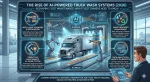
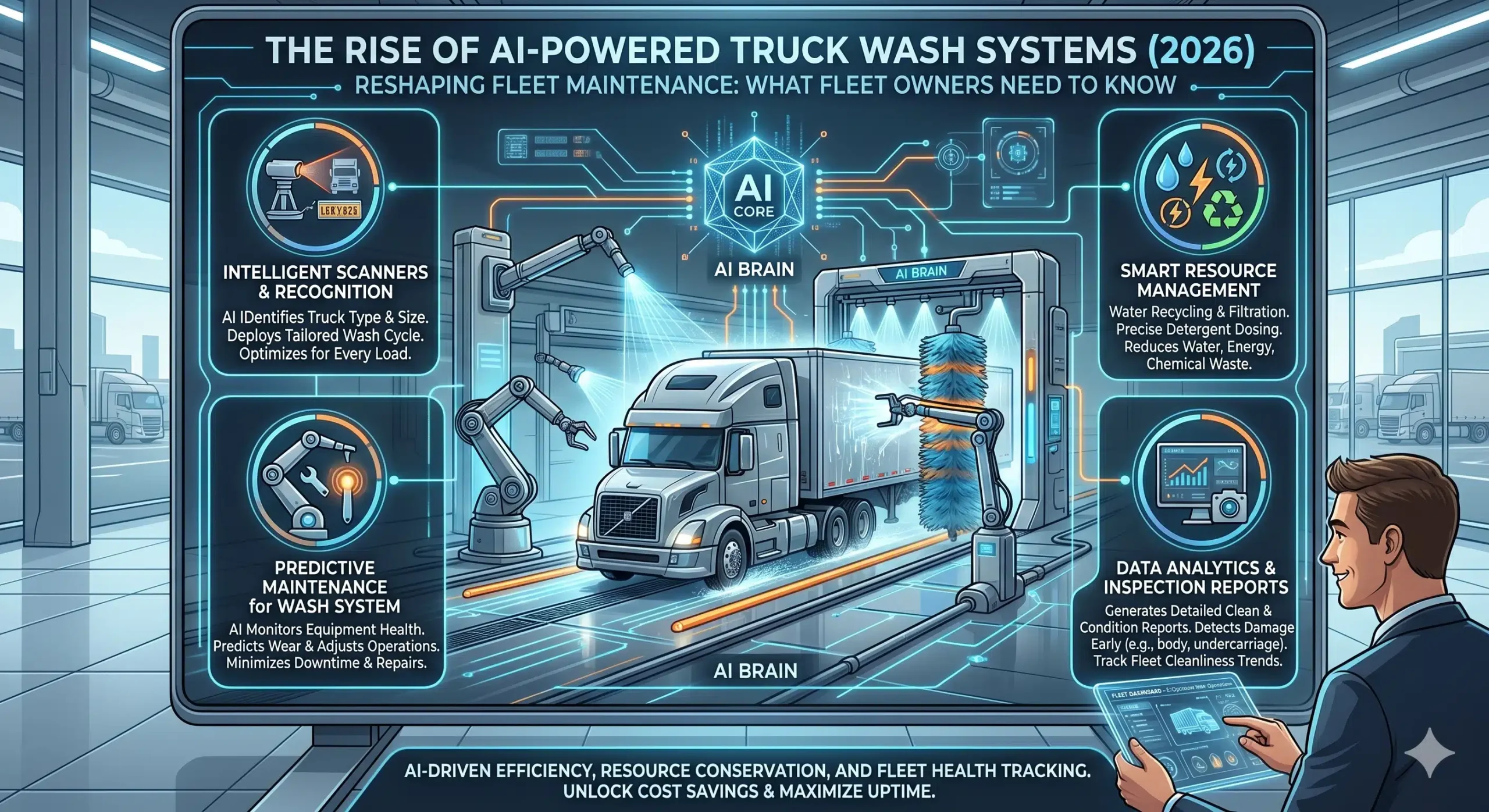
Modern touchless 3D profiling gantry systems use laser scanners and computer vision to build a real-time 3D model of each vehicle as it enters the bay. That model drives everything downstream: nozzle angle, water pressure, chemical dosing, cycle time. A cabover day cab and a long-nose sleeper with a reefer trailer get two completely different wash programs — automatically, in real time, without a human touching a control panel.
Why does this matter? Because the old “one cycle fits all” approach wasted water on small vehicles and under-cleaned large ones. A national carrier profiled in recent industry reporting saw water consumption drop 30% in the first six months after switching to an AI-scanned wash system, simply because each truck got exactly the wash it needed — no more, no less.
The other quiet revolution is predictive maintenance. IoT sensors embedded in the pumps, nozzles, and conveyors now report real-time performance data. The system flags a failing solenoid before it strands a truck mid-cycle, and it tracks water usage, chemical consumption, and cycle duration trend by trend. You stop finding out about a problem when the line backs up; you find out on a dashboard, three days earlier.
If you’re managing a high-throughput operation, LazrTek’s guide to maximizing fleet uptime and how many trucks an automated system can wash per hour digs into the real throughput numbers you should expect from a modern system.
Water Reclamation: No Longer Optional
Let’s be blunt: if you’re buying a new truck wash system in 2026 without integrated water reclamation, you’re buying a compliance problem.
According to the Washington State Department of Ecology’s Best Management Practices Manual for vehicle and equipment washwater, wash water from commercial vehicles routinely contains oil, grease, suspended solids, heavy metals, and detergent residues — all of which are regulated under the federal Clean Water Act and administered through the National Pollutant Discharge Elimination System (NPDES). Discharging that untreated into a storm drain isn’t just bad for the environment; it’s a fast track to fines, permit revocation, and in some jurisdictions, personal liability for the facility operator.
The best current systems reclaim and recycle up to 90% of water used in each cycle. That’s accomplished through a multi-stage treatment train — typically settlement tanks, oil/water separators, bag and cartridge filtration, and in higher-end systems, reverse osmosis polishing. The treated water is clean enough to reuse for the pre-soak and body wash stages, with fresh water reserved only for the final rinse.
There’s a capital cost, yes. The EPA estimates that full wash-and-rinse reclamation adds roughly 50% to the capital cost of a wash facility. But with water prices rising in most U.S. markets and NPDES enforcement intensifying, that premium pays itself back faster every year. And the chemistry matters too — pairing reclamation hardware with properly formulated detergents like LazrTek’s low-pH foam, neutral-pH foam, and biodegradable heavy-duty degreaser keeps the reclamation system happy and the discharge clean.
For operators wanting to build a fully green operation, LazrTek’s broader environmental responsibility framework outlines how detergents, water treatment, and hardware need to work as a single system.
What a Modern Wash Bay Actually Looks Like
If you haven’t walked through a top-tier fleet wash facility recently, the change is striking. A 2026-spec wash bay typically includes:
A 3D laser profiling gantry — scans the vehicle and customizes the wash cycle. LazrTek offers 2-brush and 3-brush configurations depending on your throughput needs, plus fully touchless versions for reefer units and high-gloss livery where you want zero brush contact.
Dedicated wheel and undercarriage wash — the single most important corrosion-prevention step for fleets running in the salt belt. Road salt chews through frames, brake lines, and air system components. A good undercarriage blaster pays for itself just in deferred maintenance.
Trailer washout systems — increasingly critical for food-grade, pharmaceutical, and cold-chain operations subject to FDA and USDA hygiene rules. Automated interior washout ensures hygienic, residue-free trailers with documented cycle records you can hand to an auditor.
A closed-loop water reclamation plant — the unglamorous box in the back that handles everything from initial settling to final polishing. This is where your NPDES compliance lives or dies.
A chemical dosing and recovery system — precision-metered detergent application driven by vehicle size, soil level, and wash program. No more guy-in-boots with a five-gallon bucket.
A control and analytics dashboard — the layer that ties it all together, generates compliance reports, and alerts you when something’s trending toward failure.
For operators running dense depot operations, the question of throughput is usually the make-or-break number. LazrTek’s article on the best truck wash systems for high-volume facilities breaks down what kind of hourly counts you can realistically expect.
Beyond Trucks: Every Fleet Type Is Getting the AI Treatment
One thing worth flagging: this technology wave isn’t just for over-the-road trucking. It’s reshaping every fleet category.
- School and transit buses — high public visibility, tight budgets, and unforgiving scheduling make automated wash systems an easy ROI case. LazrTek’s school bus wash system guide walks through the specific challenges of bus fleets.
- Delivery vehicles — with e-commerce volumes still climbing, last-mile fleets (Amazon DSPs, FedEx Ground contractors, regional carriers) are the fastest-growing segment for automated wash adoption. See delivery vehicle wash systems for configurations tailored to sprinter vans, step vans, and box trucks.
- RVs and motorhomes — the rental and resale market rewards immaculate units. Dedicated RV wash systems handle the height and length without the brush damage risk of a passenger car tunnel.
- Construction, mining, and military — heavy off-road vehicles require industrial-grade wash systems with significantly higher pressure and larger debris handling capacity.
How to Approach the 2026 Buying Decision
If you’re evaluating a new system this year — whether for a private fleet or a commercial wash business — here’s a practical framework.
First, start with water. Check your local water rates, your discharge permit requirements, and the sensitivity of the watershed you drain into. That tells you how aggressive your reclamation needs to be and often points to whether a closed-loop or partial-reuse system makes more financial sense.
Second, be honest about your vehicle mix. A depot that only washes cabover tractors can get away with a simpler gantry. A mixed fleet of trucks, trailers, box vans, and occasional light vehicles needs modular flexibility — that’s where hybrid brush-and-touchless systems shine, combining the soil-removal power of friction with the gentleness of touchless passes.
Third, think about throughput, not just cleanliness. A perfect wash that takes 12 minutes doesn’t help you if your dispatcher needs trucks back on the road in 6. LazrTek’s guide on choosing a truck wash manufacturer that delivers real results walks through how to match cycle time to operational reality.
Fourth, don’t underestimate parts and service. The fanciest gantry in the world becomes a liability if the manufacturer can’t get you a replacement part in 48 hours. This is a huge point in favor of domestic manufacturers with regional service footprints — LazrTek’s areas served map is a good example of what coverage density should look like.
Finally, get a consultation before you spec. Every site has quirks — slab limits, ceiling height, drainage, existing utility capacity. A good manufacturer will walk the site before quoting. LazrTek’s consulting service is built around that principle, and a free custom quote is a reasonable first step.
A Few Further Resources Worth Bookmarking
If you want to go deeper on the industry context and regulatory environment, a few outside sources consistently produce high-quality material:
- International Carwash Association (ICA) — the primary industry body, with research, training, and technical standards.
- Transport Topics — best general-purpose news source on trucking, including maintenance and sustainability trends.
- American Trucking Associations (ATA) — the go-to source for freight volume, fleet demographics, and advocacy on regulations that affect wash compliance.
- EPA NPDES Stormwater Program — the definitive reference for what you’re legally responsible for.
- Minnesota Pollution Control Agency — BMPs for vehicle washing — widely cited for its practical guidance on detergent selection and wastewater handling.
- Heavy Duty Trucking magazine — good case-study journalism on what fleets are actually implementing.
The Bottom Line
The truck wash bay in 2026 isn’t a utility expense anymore — it’s a strategic asset. The facilities that invest in AI-driven, water-smart, data-connected wash systems are getting three things at once: dramatically lower operating costs, airtight regulatory compliance, and consistent fleet appearance that translates into customer trust and higher resale values.
The operators who keep treating washing as an afterthought are going to spend the next five years writing bigger water bills, fighting NPDES violations, and explaining to their customers why their trucks look worse than the competition’s.
It’s not a close call anymore. The technology works, the ROI is documented, and the regulatory direction is only going one way. The question isn’t whether to upgrade — it’s how fast you can move.
Ready to see what a modern wash system could do for your fleet? Request a free custom quote from LazrTek or call 1-844-LAZRTEK (1-844-529-7835) to talk with our engineering team. We’ll help you size the right system for your vehicles, your site, and your compliance profile — no pressure, no templated answers.
Explore more LazrTek resources: Wash System Types · Vehicle Types We Service · Detergents · Projects · Blog