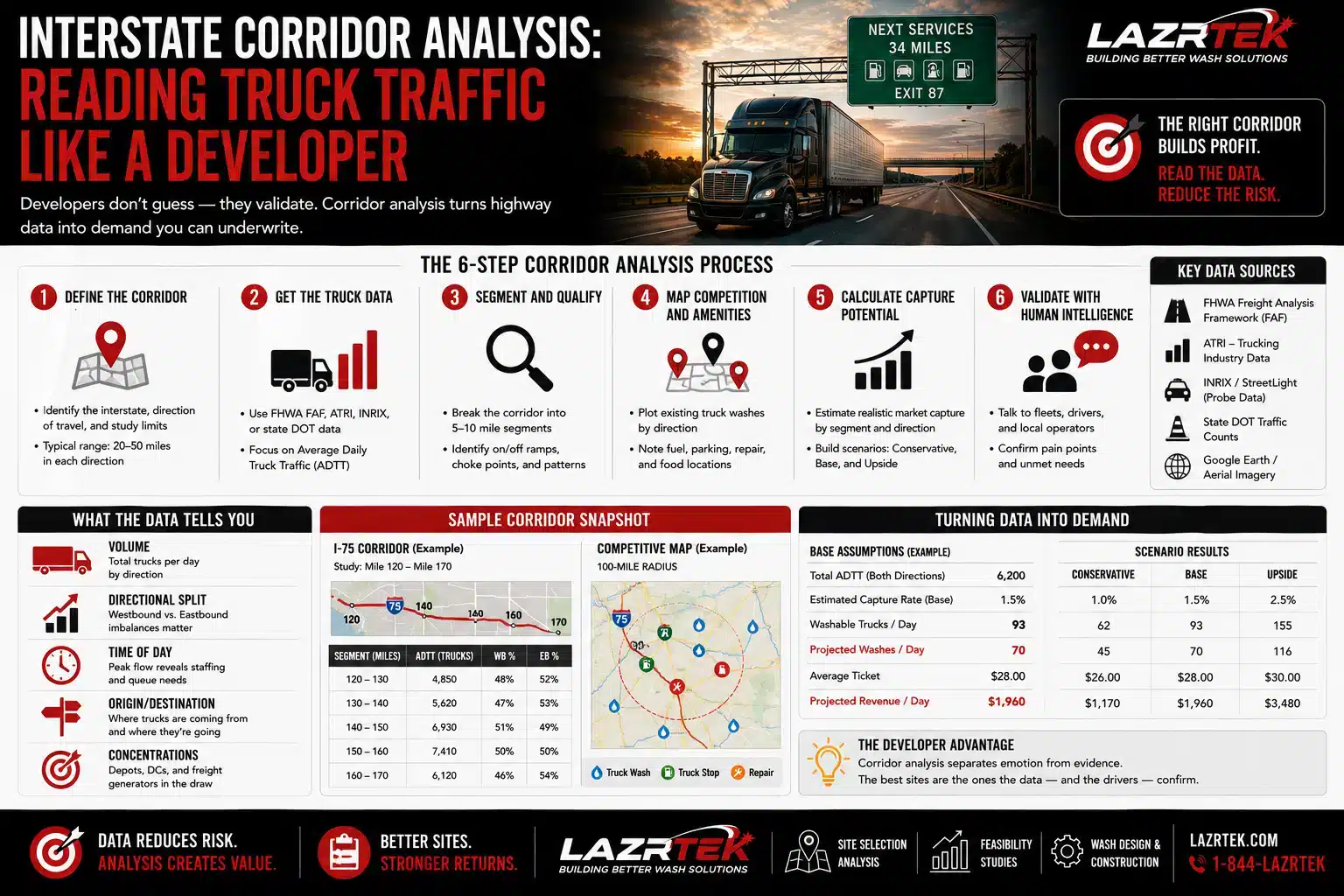
Two interchanges ten miles apart can support completely different businesses. Corridor analysis is how you know which one you’re buying — before the closing, not after.
Truck AADT is the only count that matters
Total traffic (AADT) flatters every site. The number that pays your note is truck AADT — the share of daily volume that’s commercial vehicles, which varies dramatically segment by segment. State DOT count stations and federal freight sources like the Bureau of Transportation Statistics publish it; a developer reads the segment-level data, not the state average.
Direction, time, and season
Corridors have personalities. Directional splits tell you which side of the highway deserves the wash. Time-of-day curves predict your queue profile and staffing. Seasonal patterns — harvest, holiday freight, winter salt runs — shape the revenue calendar your pro forma must respect.
The interchange math
Passing trucks aren’t customers; exiting trucks are. Interchange design decides how costly it is for a driver to reach you and rejoin the flow — minutes of detour matter to drivers governed by hours-of-service rules that make time a hard currency. Sites that pair pass-by volume with a low-friction exit-and-return capture disproportionately.
From data to decision
Corridor reading is the first layer of LazrTek site selection analysis — traffic heat, anchor mapping, and A/B/C site scoring — and its outputs become the demand model inside the feasibility study. The map decides more than the machinery ever will.