Fleet washing is one of the few significant recurring expenses that rarely gets a proper analysis. Fuel gets modeled to the penny. Tires get tracked by position. Maintenance gets a whole software category. Washing gets a vendor, an invoice, and a line item nobody has revisited since the vendor was selected.
That is understandable — on a per-unit basis it looks small. But the decision to keep outsourcing or to build a bay at your own terminal is a genuine capital decision with a genuine payback period, and most fleets have never run the numbers well enough to know which side of the line they are on.
Here is the full comparison, including the costs that never appear on an invoice.
Start With Your True Outsourced Cost
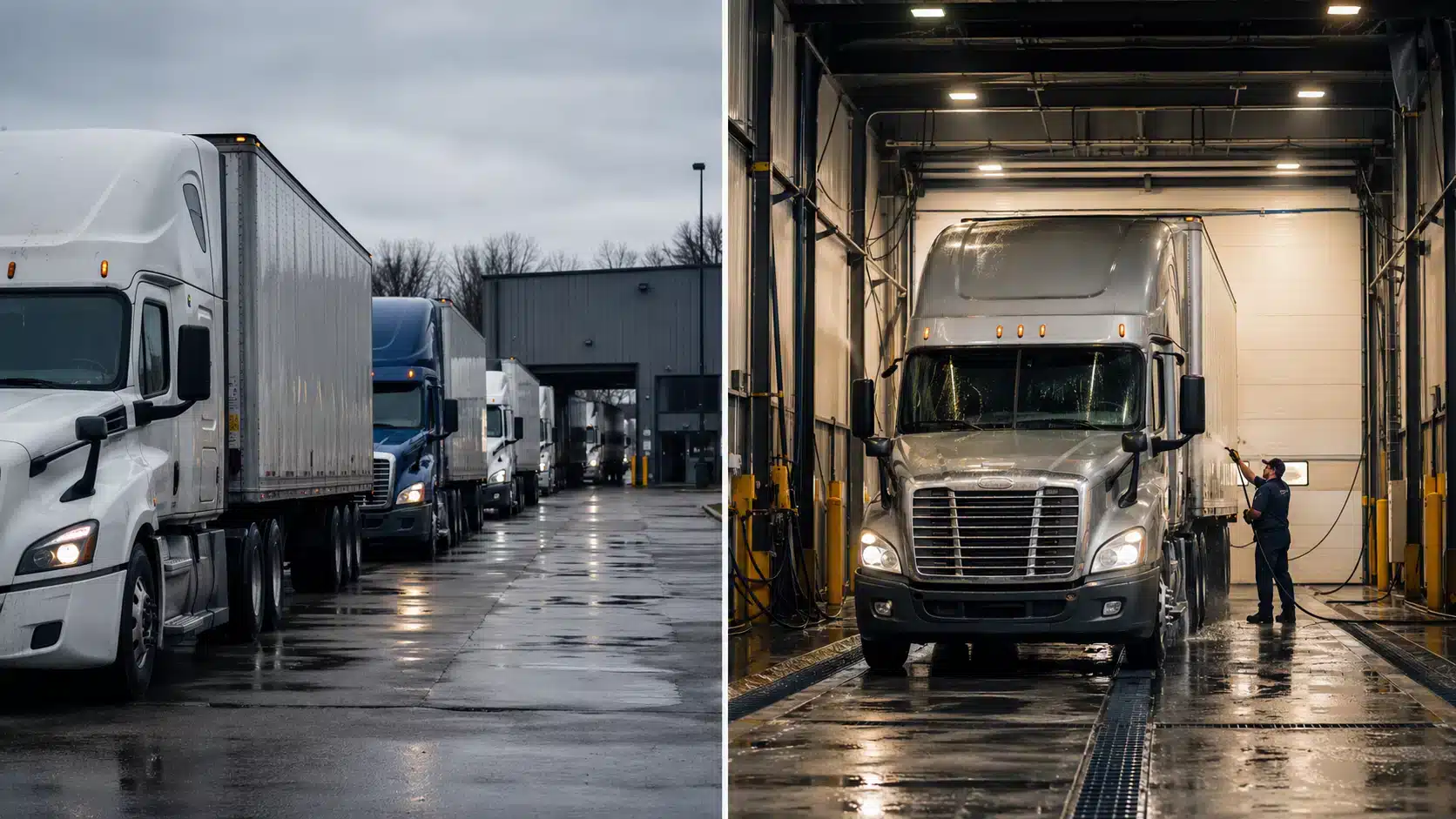
Nearly every fleet that outsources knows its per-wash rate. Very few know its per-wash cost, and the difference is usually large.

Build the real number from these components:
The invoice. Your negotiated rate per tractor, per trailer, per combination unit. Straightforward, and the only piece most fleets track.
Driver labor. This is the big one. Count the time from when the unit leaves its normal path to when it returns — the drive out, the wait in queue, the wash cycle, and the drive back. At a commercial wash during a busy afternoon, queue time alone can exceed the wash. Multiply the total by your fully loaded driver cost per hour, which includes wages, payroll taxes, and benefits, not just the base rate.
Deadhead miles. Fuel, tolls, and per-mile maintenance accrual for every mile driven to and from the wash that serves no revenue purpose. Use your actual cost-per-mile figure. Fleets track this number carefully for every other purpose and then forget to apply it to washing.
Equipment hours and wear. Engine hours, brake wear, and tire wear accumulated in a queue and on a detour. Small per trip, not small annually.
Opportunity cost. If the tractor is out of service for ninety minutes and your operation is capacity-constrained, that is revenue time. If you are not capacity-constrained, it is not — be honest with yourself here, because inflating this line is the fastest way to build a business case that does not survive review.
Scheduling friction. The cost that does not fit a spreadsheet: units that do not get washed because the timing never worked, appearance standards quietly slipping, and drivers arriving at a customer site in a truck that reflects poorly on the company.
Now run it. A fleet of 60 tractors washing every two weeks makes roughly 1,560 wash events a year. If the invoice is one figure and the loaded driver and mileage cost of getting there and back is comparable, the true annual spend is roughly double what the accounts payable line shows. That is the number the capital decision should be measured against — not the invoice.
What It Costs to Run Your Own
The other side of the ledger has more lines, and fleets almost always underestimate the operating side while overestimating the capital side.
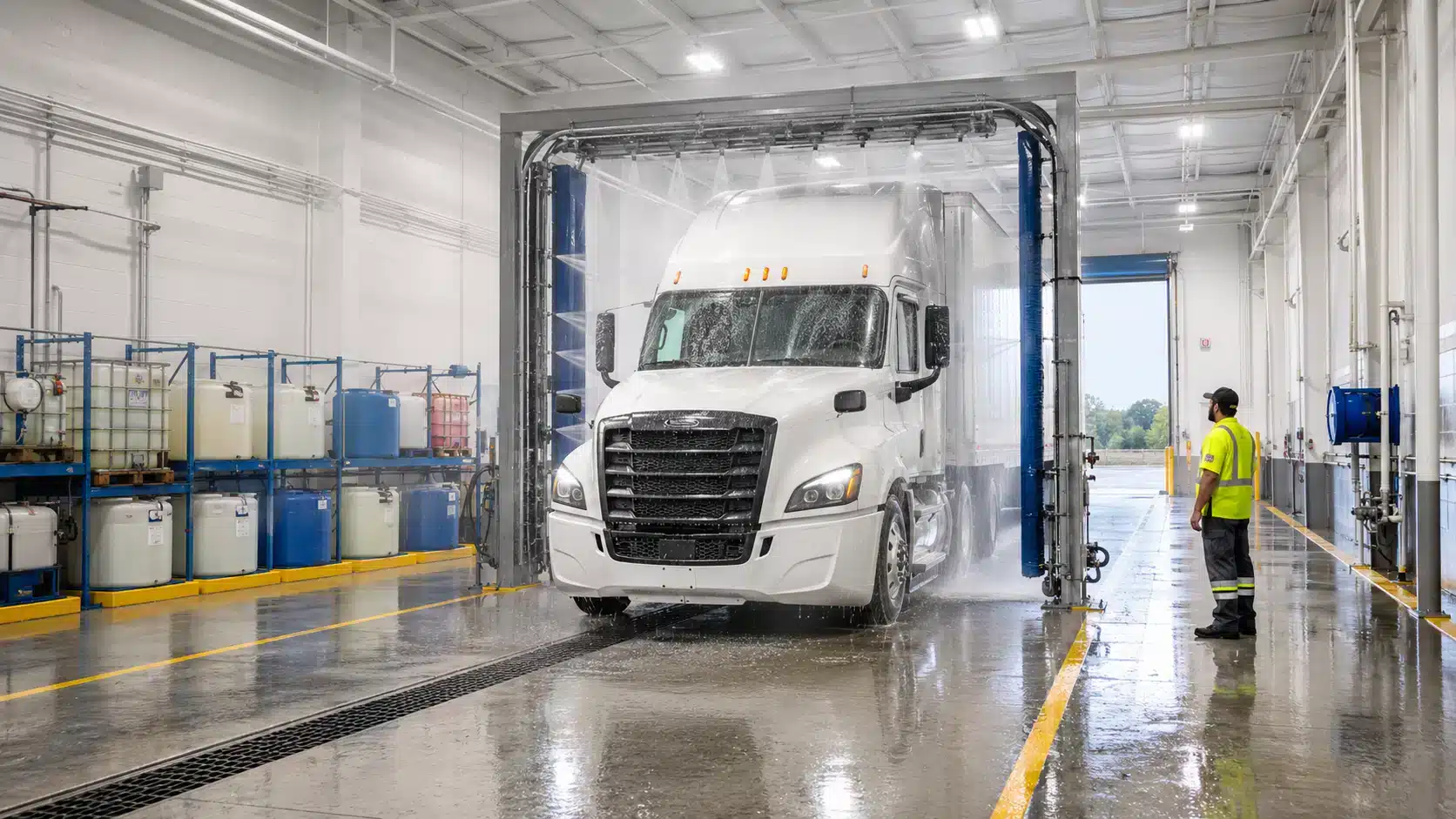
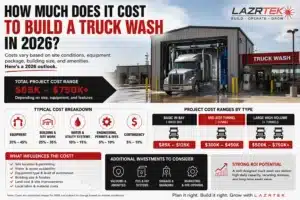
Capital. The wash system, the bay or canopy structure, the engineered concrete pad and drainage, water and electrical service, water treatment and reclaim, and the oil-water separator. A gantry or rollover system at a single terminal is the entry point; a drive-through system costs more and moves more units per hour. Financing this changes the shape of the comparison: an equipment lease or loan converts a lump capital figure into a monthly payment that sits directly alongside the invoice you are replacing, which is usually the fairest way to present the decision internally.
Chemistry. Use a measured or quoted cost for the specified products, dilution, water quality, soils and wash sequence. Verify dosing and consumption rather than assuming a universal cost per truck. Compare chemical cost together with cleaning results and surface compatibility.
Water and sewer. Fresh water purchase plus discharge cost. Where a municipality applies an industrial strength surcharge, that is a separate and sometimes substantial line. Reclaim reduces both.
Energy. Pumps, motors, blowers, and heat. In cold climates, freeze protection runs whether you are washing or not.
Labor. Budget the time required for staging, preparation, monitoring, chemistry checks, maintenance and exceptions. Staffing depends on the configuration, safety procedures and operating schedule. A driver-operated cycle still uses paid time; do not assign it zero labor cost without measurement.
Maintenance. Include nozzles, seals, sensors, pump service, preventive work, replacement parts and downtime allowances for the proposed system. Use the supplier’s maintenance plan and your operating conditions rather than assuming a guaranteed asset life.
Compliance. Separator pump-out by a licensed hauler, permit monitoring and reporting, and record retention.
Insurance and property. Added coverage, and in some jurisdictions added property tax on the improvement.
The Comparison That Actually Decides It
Put both sides into annual terms and compare like for like.
Outsourced annual cost = wash events per year × (invoice rate + loaded driver time + deadhead cost + equipment wear)
In-house annual cost = financing or depreciation + fixed operating costs + (wash events × variable cost per wash)
The result depends on the inputs. Fixed ownership costs may be spread across more wash events, but an in-house advantage is not automatic. Vendor volume discounts, staffing changes, maintenance, utility capacity and wash requirements can change both sides. A crossover exists only when the cost assumptions produce one; test more than one realistic scenario.
Finding that crossover point is the entire analysis. What moves it:
Wash frequency. A fleet washing weekly reaches the threshold at a much smaller unit count than one washing monthly.
Distance to the nearest commercial wash. This is often the deciding variable and the one most underweighted. A fleet with a good wash across the street from its terminal has a genuinely cheap outsourced option. A fleet whose nearest option is a forty-minute round trip is paying far more than its invoice suggests, regardless of unit count.
Driver cost. In tight labor markets, driver time is expensive, and time spent in a wash queue is time not spent driving.
Terminal concentration. A fleet domiciled at one or two terminals is a strong candidate. A fleet dispersed across many small locations usually is not, because you would be building multiple facilities to serve fractional volumes.
Wash requirements. Food-grade carriers needing documented interior trailer washouts, tankers requiring specific procedures, and fleets in heavy-salt regions needing undercarriage treatment all have needs that commercial retail washes may serve inconsistently or not at all. When outsourcing means driving past three washes to reach the one that does what you need, the case for in-house strengthens considerably.
The Benefits That Do Not Fit the Spreadsheet
Several real advantages of in-house washing resist clean quantification. They should be named in the analysis rather than either ignored or used to paper over weak numbers.
Consistency and control. You set the standard, the frequency, and the process. Appearance stops depending on whether a driver had time.
Scheduling. Units get washed when they are already at the yard, between shifts, during time that would otherwise be idle. This is often where the real labor savings live — washing stops consuming productive hours entirely.
Corrosion management. Regular undercarriage washing in salt regions extends component and vehicle life. Brake lines, air lines, wiring, and frame members are what corrode, and their failure drives both repair cost and unscheduled downtime. Over a decade of ownership, this can be a larger number than the wash cost itself.
Documentation. For food-grade and regulated operations, controlling the wash means controlling the record. If you have to prove a trailer washout happened and to what standard, owning the process is materially simpler than reconstructing a vendor’s paperwork.
Recruiting and retention. Drivers notice equipment condition. It is not the top factor in retention, but it is not nothing either, and neither is what your equipment says to customers at the dock.
The Option Most Fleets Overlook
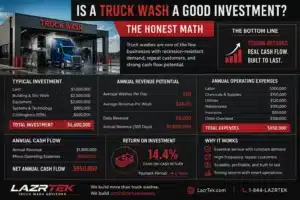
There is a third answer that is frequently better than either pure alternative: build a facility sized somewhat above internal demand and sell the surplus capacity.
Internal fleet demand may leave unused capacity, but outside washes still incur labor, chemistry, water, energy, maintenance, payment and administrative costs. Model that incremental cost and credible customer demand before counting outside revenue. Existing equipment does not make additional washes free.
This changes the project meaningfully. Retail operation brings public access, payment and account systems, signage, marketing, insurance implications, and possibly different permitting. Those are all manageable, but they need to be designed in rather than bolted on — the site layout, the approach and exit, and the utility sizing all differ if you expect outside traffic.
Fleets sitting on a well-located parcel near an interstate corridor are, in effect, holding an undeveloped wash site. Whether that is worth pursuing depends on corridor traffic, competition, and how much capacity you would actually have to sell. It is a straightforward question for a feasibility study and a difficult one to answer from intuition.
How to Decide
A defensible answer takes four steps.
- Measure your current true cost. Pull twelve months of wash invoices. Sample actual door-to-door times for wash trips rather than estimating. Apply your real loaded driver rate and cost per mile. You will likely find the number is well above what you assumed.
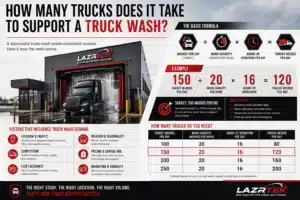
- Size the facility against your operation. Units, frequency, and available washing windows determine throughput, which determines format. A gantry serves many single-terminal fleets well; a drive-through is for high volume or narrow windows.
- Price the complete project. Equipment, structure, civil, utilities, water treatment, separator, and permitting — then structure the financing so the comparison is monthly payment against monthly invoice.
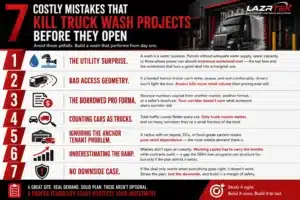
- Verify the site can take it. Sewer availability, discharge permitting, separator sizing, and surcharge exposure are the things that most often change a project’s economics after the decision is made. Check them first.
If the comparison is close, test the sensitivity to volume, travel time, utility rates, maintenance and financing terms. Obtain a complete project quotation and site review before making a capital decision. A favorable operating-cost comparison is not proof of payback or a guaranteed return.
Frequently Asked Questions
At what fleet size does an on-site wash make sense?
There is no universal number. Test annual wash volume against annual ownership cost instead: units × washes per year × fully loaded outsourced cost per wash, compared to financing plus operating cost of a bay. Single-terminal fleets washing frequently reach the crossover at far smaller unit counts than dispersed fleets.
What is the true cost of outsourced washing?
Invoice plus driver wages for travel and queue time, fuel and deadhead miles, equipment wear, and opportunity cost where you are capacity-constrained. For fleets whose nearest wash is a real detour, non-invoice costs often equal or exceed the invoice.
How many people does a private wash bay need?
Staffing depends on the configuration, vehicle preparation, safety procedures, wash schedule and required maintenance. Ask for a task-based operating plan. Driver-operated equipment still consumes driver time and requires appropriate training.
What are the ongoing costs?
Include chemistry, water and sewer charges, energy and heat, labor, maintenance and parts, separator service, required monitoring and reporting, insurance, and financing or depreciation. Measure the variable lines and allocate fixed costs consistently; avoid counting both full capital payments and depreciation in the same simple comparison.
Can a private wash earn outside revenue?
Frequently. Capacity idle outside peak hours can be sold to local carriers and neighboring fleets. Plan it during design, because public access changes permitting, insurance, payment systems, and site layout.
Want the numbers for your fleet specifically? A LazrTek feasibility study models your true outsourced cost against a sized, priced facility on your own site — including the surplus-capacity revenue case if your location supports it. We also structure equipment financing so the comparison is monthly payment versus monthly invoice.