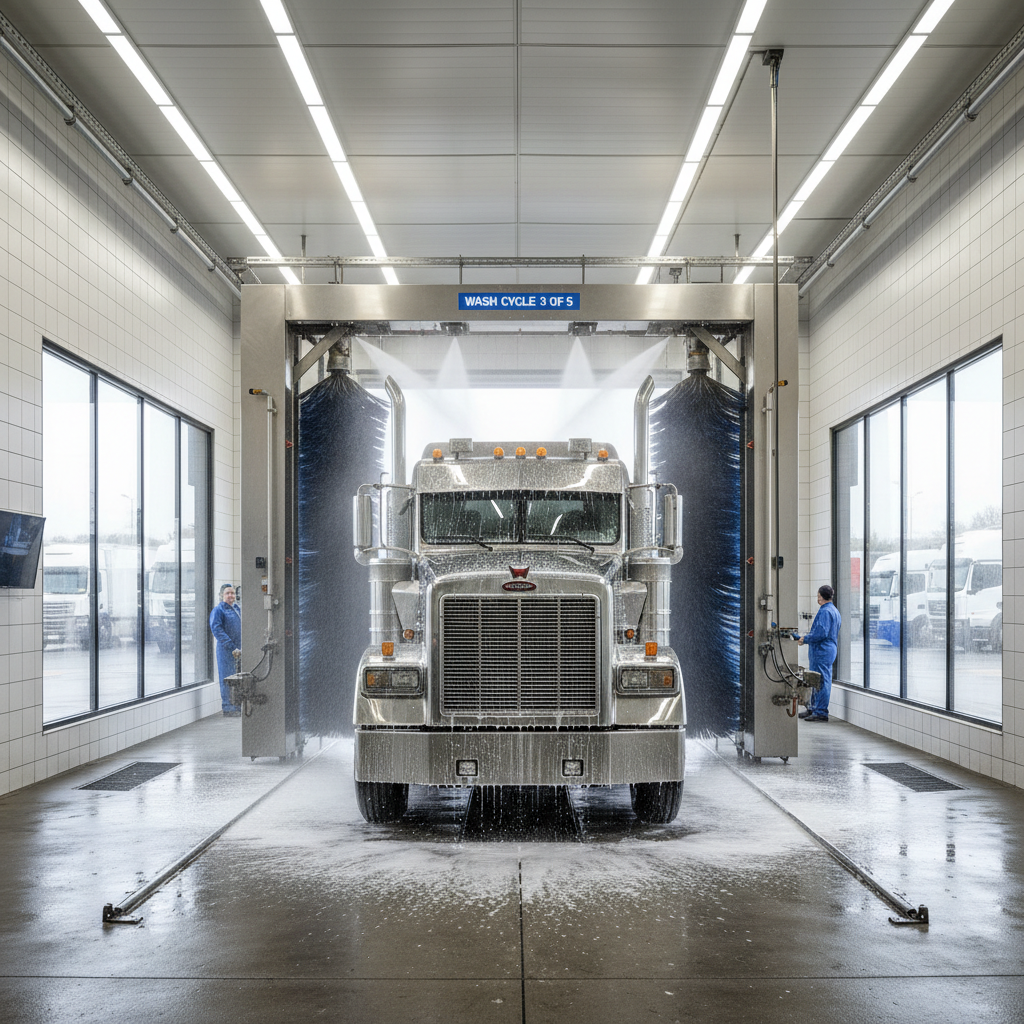
Running a high-volume truck wash facility is a different challenge entirely from washing a few vehicles a day. When dozens—or hundreds—of commercial trucks cycle through your bays daily, every decision you make about equipment, technology, and infrastructure has a direct impact on throughput, operating costs, and long-term profitability. The wrong system means queues backing up, trucks sitting idle, and revenue walking out the door.
This guide breaks down the most important decisions facing operators of high-volume truck wash facilities: system layout, wash technology, water management, automation, ROI, and maintenance. Whether you’re building a new facility from the ground up or upgrading existing infrastructure, what follows gives you the technical foundation to make the right call for your operation.
Drive-Through vs. Gantry: Choosing the Right System Layout
System layout is the first and most consequential decision you’ll make. There are two primary options: drive-through and gantry. Each has a fundamentally different operational profile.
Drive-Through Truck Wash Systems
In a drive-through system, the wash equipment is fixed to the ground and the truck moves through it. This is the preferred configuration for high-volume operations. A well-configured drive-through system can clean a 70-foot tractor-trailer in approximately two minutes—a fraction of the time required by other formats. Drivers remain in their cabs throughout the process, which improves safety and eliminates delays associated with driver interaction.
Drive-through systems also offer significant customization flexibility. Operators can add brush modules, spot-free rinse systems, blow dryers, wax and sanitizer application, and water reclamation infrastructure depending on their specific fleet requirements. Maintenance costs tend to be lower than gantry alternatives due to fewer moving parts.
For facilities handling mixed fleets—tankers, flatbeds, box trucks, refrigerated trailers—drive-through systems with touchless wash configurations are particularly well-suited, as they can accommodate irregular vehicle shapes without risk of contact damage.
Gantry Truck Wash Systems
In a gantry system, the vehicle parks and the wash machine moves around it. The primary advantage is consistency: because wash speed is machine-controlled rather than driver-controlled, every vehicle receives the same treatment regardless of who’s behind the wheel.
Gantry systems work well in confined spaces and excel with homogeneous fleets where every vehicle has the same dimensions. However, a standard gantry cycle takes approximately 10 minutes to complete. At that rate, throughput is capped at roughly six vehicles per hour per bay—a significant constraint for high-volume operations.
Gantry systems also carry higher maintenance costs due to their additional moving components, and non-standard vehicles such as tankers or ribbed-sided trailers can present cleaning and damage risks.
The verdict for high-volume facilities: Drive-through systems are the clear choice when throughput is the priority. Gantry systems remain a strong option for private fleets where cleaning consistency across a uniform fleet outweighs raw speed.
Touchless vs. Friction Brush: Selecting the Right Wash Technology
Both drive-through and gantry systems can be configured with either friction (brush) or touchless wash technology. Understanding the difference between these two methods is critical for fleet operators managing expensive assets.
Friction (Brush) Wash Systems
Friction washes use large rotating brushes to physically scrub the vehicle surface. The mechanical action is effective at removing heavy mud and thick road grime, and it typically requires lower chemical concentrations than touchless alternatives. Brush washes also tend to be faster since they do not rely entirely on chemical dwell time.
The downside is significant for high-value fleets. Dirt and debris can become embedded in brush bristles, causing micro-scratches and swirl marks that damage paint and branded decals over time. Irregular vehicle shapes—mirrors, antennas, sensors, and custom lighting—are all at risk of contact damage. For fleets that invest in high-quality wraps or custom graphics, the cumulative cost of brush-related wear can be substantial.
Touchless Wash Systems
Touchless systems use chemistry and high-pressure water to remove contamination without any physical contact. The process relies on a proven two-step chemical approach: a low-pH pre-soak neutralizes the static bond holding road film, oxidation, and mineral deposits to the surface, followed by a high-pH alkaline detergent that attacks grease, carbon-based grime, and oils. A high-pressure rinse then removes all loosened contamination.
The practical advantages for fleet operators are compelling. No contact means no scratches, no torn mirrors, no damaged sensors. Touchless systems can clean virtually any road-legal vehicle—buses, garbage trucks, flatbeds, tankers, and personal vehicles—using the same wash infrastructure. This makes them the natural choice for facilities that handle diverse or mixed fleets.
One technical consideration: polished aluminum surfaces require carefully calibrated chemical concentrations. If detergents are too strong, aluminum can oxidize and turn white. Proper system calibration is essential for fleets with aluminum components.
The verdict for high-volume facilities: Touchless wash technology is the preferred choice for protecting vehicle assets and managing mixed fleets. For facilities dealing with extreme mud and heavy off-road contamination, a well-maintained friction system may be justified—but operators should weigh the long-term vehicle damage costs carefully.
Water Reclamation and Recycling Infrastructure
For a high-volume truck wash facility, water is one of the largest operating expenses. A commercial touchless truck wash can use substantial volumes of fresh water per cycle; without reclamation infrastructure, those costs compound quickly across hundreds of daily washes.
According to research by the International Carwash Association and cited by the U.S. EPA, vehicle wash facilities using reclamation systems can fulfill an average of 51% of their water needs from reclaimed water, with overall freshwater consumption reductions of approximately 50%. Some facilities report water and sewer bill savings as high as 80% following reclamation system installation.
Key Components of a Truck Wash Water Reclamation System
An effective reclamation system consists of several treatment stages:
Settling and sedimentation: Wastewater enters a settling pit where heavy solids and coarse particulates separate and sink. Tanks are typically designed with sloped bottoms for efficient sludge removal. Routine pump-out prevents clogging and overflow.
Oil-water separation: An oil-water separator with a grit-settling chamber removes hydrocarbons and suspended solids. This is particularly important for truck wash facilities where engine runoff, road oils, and grease are common contaminants. Oil recovered from separators can typically be managed as used oil and sent to a recycler.
Filtration: Multi-stage filtration removes fine particles down to 40 microns, which is the threshold required to protect equipment from abrasive wear and prevent finish damage on vehicles. Options include sand filters, pressure media filters, and cyclone separators depending on water volume and contamination load.
Disinfection and odor control: High-volume reclaim systems can develop bacterial growth and odors without active treatment. Oxidation systems using ozone, chlorine, UV light, or catalytic UV-ozone combinations prevent foul odors and maintain water quality in continuous circulation.
Biological treatment systems represent the most advanced option, using microorganisms to decompose dissolved organic matter including oils, greases, and surfactants. These systems produce crystal-clear, odor-free water with freshwater savings of up to 98% and can treat multiple wastewater streams across the facility.
Environmental Compliance Considerations
High-volume truck wash facilities are subject to stormwater management regulations, pretreatment permit requirements from local publicly owned treatment works (POTWs), and in some jurisdictions, specific industrial wastewater permits. Facilities should implement covered wash bays or stormwater diversion valves to prevent rainwater from overloading reclaim capacity. Any unauthorized release of untreated wastewater exceeding regulatory thresholds must be reported to the relevant environmental authority.
Water reclamation systems represent both an environmental compliance strategy and a direct operating cost reduction. Installation costs vary but the EPA estimates reclamation system retrofits at approximately $35,000—a figure that typically yields payback within months to two years depending on wash volume and local water rates.
Automation Features to Maximize Throughput
At high wash volumes, manual processes create bottlenecks. Every minute a driver spends waiting to pay, verify credentials, or interact with staff is a minute of lost throughput. Modern automation technology eliminates these friction points and allows facilities to operate efficiently with reduced staffing requirements.
RFID Fleet Identification
Radio Frequency Identification (RFID) systems use tamper-proof tags mounted on vehicle windshields to automatically identify fleet vehicles as they approach the wash entry. The system reads the tag, verifies account status, selects the pre-assigned wash package, and triggers gate release—all without driver interaction. For commercial fleet accounts, RFID supports prepaid, postpaid, and unlimited billing structures, with multiple vehicles billable under a single account.
License Plate Recognition (LPR)
License Plate Recognition (LPR) and Automatic License Plate Recognition (ALPR) systems offer an alternative to physical tags, identifying vehicles by scanning their license plates with high-resolution cameras. Systems like those from Inex Technologies deliver recognition accuracy of up to 99% and can integrate directly with point-of-sale systems to trigger wash authorization and transaction processing. LPR is particularly valuable for facilities without on-site staff to manage tag enrollment, and it effectively prevents membership sharing across unauthorized vehicles.
Automated Pay Stations and POS Integration
Self-serve pay kiosks allow drivers to select wash packages and complete payment without staff involvement. When integrated with fleet account management software, these systems can apply pre-negotiated discount rates, track wash counts against contract limits, and generate billing reports automatically. Cloud-based platforms enable remote monitoring of transaction data, kiosk status, and real-time wash counts—giving operators full visibility without requiring on-site presence.
Together, RFID, LPR, and automated payment infrastructure can materially reduce labor requirements, shorten queue times, and increase the number of vehicles processed per hour.
Evaluating Cost Per Wash and Long-Term ROI
Capital expenditure sensitivity is a common objection when evaluating high-performance truck wash equipment. A structured ROI analysis addresses that concern directly.
The cost-per-wash calculation for a commercial truck wash facility encompasses:
- Water and sewer costs (significantly reduced with reclamation infrastructure)
- Chemical consumption (lower in friction systems; higher but more targeted in touchless)
- Labor costs (reduced substantially with automation)
- Maintenance and downtime costs (lower in drive-through systems with fewer moving parts)
- Vehicle damage costs (significantly lower with touchless technology)
- Energy consumption (pumps, heating, recirculation, air dryers)
The ROI case for automated, high-throughput drive-through systems with reclamation is built on multiple simultaneous cost reductions: water savings of up to 50% from reclamation, labor reductions from automation, lower vehicle repair and repainting costs from touchless washing, and faster cycle times that increase revenue per hour of operation.
Facilities evaluating new systems should model these savings against capital cost across a 5- to 8-year horizon. Manufacturers often provide ROI calculators that allow operators to input site-specific variables including daily wash volume, water rates, labor rates, and current chemical spend.
Maintenance Strategies for High-Frequency Operations
High-volume operations place sustained stress on wash equipment. Proactive maintenance is not optional—it is the operational foundation that protects uptime and prevents costly emergency repairs.
Preventive maintenance schedules should be established in accordance with manufacturer specifications and maintained with written logs. This includes daily checks of filter gauges, oil skimmer function, and chemical dosing levels; weekly inspection of sedimentation trenches and cartridge filter condition; and semi-annual servicing of filtration media, membrane systems, and UV disinfection chambers.
Chemical compatibility must be verified at every stage. Cleaning agents used in high-volume facilities should be neutral pH, readily biodegradable, and low-foaming to protect reclamation system performance. Highly emulsifying detergents can impair oil-water separation and degrade overall water quality.
Staff training is equally critical. Employees should understand how to identify leaks and spills, perform visual inspections of the reclaim system, handle chemical storage safely, and respond to equipment faults before they escalate. A well-trained team reduces reactive maintenance calls and extends the service life of equipment.
Parts availability and manufacturer support should be factored into equipment selection. For a high-volume facility, equipment downtime translates directly into lost revenue. Selecting systems from manufacturers with established service networks, spare parts availability, and responsive technical support is a risk management decision as much as a procurement one.
Selecting the Right Equipment for Your Facility
The highest-performing truck wash facilities share a consistent profile: automated drive-through layouts with touchless wash technology, integrated water reclamation infrastructure, RFID or LPR-enabled fleet management, and systematic maintenance programs. These are not independent choices—they function as an interconnected system where each component reinforces the others.
For high-volume operations, the investment case is clear. Faster cycle times increase revenue capacity. Touchless technology protects vehicle assets and reduces damage claims. Water reclamation cuts utility costs by up to 50% or more. Automation eliminates labor bottlenecks and reduces staffing overhead. Together, these systems deliver measurable, compounding returns across the life of the investment.
Choosing the right configuration for your specific site depends on fleet composition, daily wash volume, available footprint, water and sewer rates, and local environmental compliance requirements. A thorough site assessment and manufacturer consultation will help you match equipment specifications to your operational reality.
The goal is straightforward: get more trucks through your facility, faster, at a lower cost per wash, with less wear on equipment and vehicles. The right system makes all of that achievable.