A LazrTek Industry Analysis; Lazrtek is U.S. based truck wash feasibility analyst and a truck wash equipment manufacturer
18 wheel tractor-trailer trucks don’t stop moving because a wash system is down. Neither does regulatory exposure, fleet depreciation, or the judgment your customers make the moment one of your units pulls into their yard. When we talk to fleet operators and truck wash facility owners about equipment sourcing, the conversation almost always drifts toward price per unit. That’s the wrong starting point. The right starting point is operational risk—and nothing shapes that risk more than where your equipment comes from and who stands behind it when something goes wrong.
The Scale of the Problem (and the Opportunity)
In 2024, trucks moved 72.7% of US freight by weight—11.27 billion tons and $906 billion in gross freight revenues. There are nearly 14.89 million commercial trucks registered in the United States, with more than 580,000 active licensed motor carriers operating them. Of those carriers, 91.5% operate 10 trucks or fewer.
That last figure matters. Small and mid-sized fleets can’t absorb the costs that large carriers shrug off—extended downtime, compliance violations, and accelerated vehicle wear. For operators in this majority bracket operating 10 trucks or fewer, professional washing infrastructure isn’t a luxury. Professional wash services is a management tool that saves small fleets money.Domestic Wash Manufacturing Changes the Risk Equation
U.S. Domestic wash manufacturers, USA Made makes a real difference
There’s a version of this conversation where we just talk about quality. American-made equipment, American standards, American inspections. All of that is true, and none of it is the real point.
When a truck wash system is designed and fabricated in the US, the people who built it are reachable . Lead times for Wash delivery shrink. Quality issues surface during production, not six weeks after a container clears customs. Replacement parts ship from a domestic warehouse, not from an overseas facility operating on a 12-hour time difference.
For fleet operators running tight margins and tighter schedules, proximity is not a soft benefit. It is a hard operational advantage.
American Trucks Are Not Generic Equipment
A US-spec semi-trailer is not built to the same dimensional standards as its European or Asian counterpart. Cab heights vary. Axle configurations differ. Trailer lengths run across a wide range depending on cargo type and state regulations. A wash system designed generically—or designed around foreign fleet norms—will not serve American equipment the way purpose-built domestic engineering does.
US manufacturers design and build around these realities from the first drawings. Gantry clearances are sized for American freight configurations. Pressure profiles are tuned to the soiling profiles that come with long-haul American trucking—not to the lighter-duty cycles common in other markets. This pecificity shows up in cleaning results and in vehicle longevity.
Environmental Compliance Is Not Optional, and It’s Getting Stricter
This is where operators find out whether their equipment vendor understood American regulatory requirements when they built the system—or whether they’re finding out the hard way.
The United States Environmental Protection Agency (EPA) classifies commercial vehicle wash water as a non-stormwater discharge. Vehicle wash wastewater cannot enter storm drains. Full stop. Operators must route wash water to a sanitary sewer or treat it on-site. The contaminants involved—oil, grease, suspended solids, heavy metals, chemical residue from cleaning products—are harmful to aquatic systems and attract enforcement attention at both the federal and state levels.
The preferred environmental compliance approach, recognized by state environmental agencies across the USA, is zero discharge: closed-loop water recycling. Advanced systems built by US manufacturers now achieve up to 90% water reuse per wash cycle. That figure has two effects. It keeps operators on the right side of discharge regulations. And it cuts utility costs in ways that compound meaningfully over the life of the equipment.
On the chemical side, best practice guidance recommends phosphate-free, non-toxic, biodegradable detergents—but even those require proper treatment before discharge. Operators who buy systems without integrated chemical management from a supplier who understands these standards often discover the gap at the worst possible time.
Hand-Washing Cost Savings Do NNot Hold Up at Operational Scale.
We hear the same reasoning consistently: manual washing or outsourcing to a third-party service is less expensive upfront. That calculation is accurate for a single truck on a single day. It falls apart when you run it across a fleet over a full year or longer.
Manual washing is labor-intensive and produces inconsistent results. Outsourcing introduces scheduling dependencies and variability in quality—and most commercial facilities aren’t set up to properly handle semi-trucks. Mobile contractors are weather-dependent and capacity-constrained.
Truck wash bays with on-site water reclamation requires an investment of $250,000 to $500,000, depending on throughput volume and wash system configuration. That is equivalent to a real capital commitment for a fleet wash. It’s also a one-time investment that eliminates recurring labor costs, reduces water and chemical consumption, and stops the clock on vehicle corrosion that accumulates wash by wash when cleaning is inconsistent or nonexistent.
When you model those savings against a realistic wash volume and a 10-year equipment horizon, the ROI case for professional domestic equipment is not close.
Parts Availability and Service Access Are Where Deals Fall Apart
Capital equipment earns its keep by running. A truck wash system sitting idle for three weeks because a replacement component is stuck in international freight is not an asset—it’s a revenue hole with a price tag attached.
Domestically manufactured truck wash systems are customarily supported by domestically stocked parts. Regional service technicians are reachable and deployable on timelines that work for an operating facility. Warranty claims don’t require navigating international coordination. As technology continues to advance—better water management, IoT integration, updated pressure profiles—upgrade paths exist through the same supplier relationship you already have.
That ongoing support structure is a significant and undervalued part of the total value proposition for US-built equipment.
The Automation Dividend
The next generation of commercial truck wash equipment is already in the field. Modern gantry systems track wash counts, cycle times, water usage, and device run time in real time. Remote access lets operators monitor performance and spot inefficiencies without being on-site. Predictive maintenance flags component wear before failure occurs.
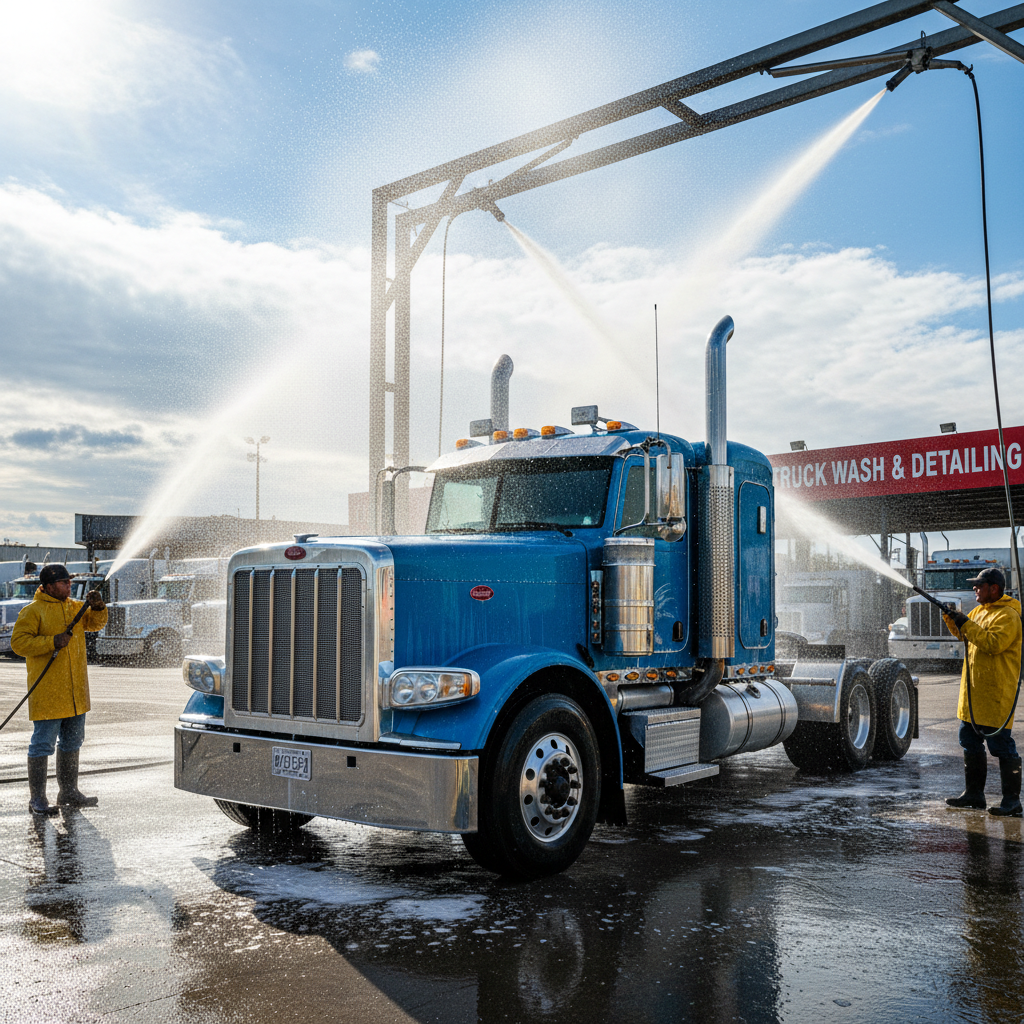
Touchless wash bay equipment configurations using high-pressure water jets protect sensitive components—aerodynamic fairings, custom graphics, precision seals—from the friction damage that brush systems can produce. Spot-free rinse technology, powered by reverse osmosis filtration, removes dissolved solids and eliminates water spotting—a detail that matters when your fleet is a rolling brand statement.
Truck Fleet Operators who invest in automation-ready, IoT-enabled wash systems now are positioned to scale without wholesale infrastructure replacement as volume grows and compliance requirements continue to tighten. Fleet Operators who defer the decision inherit older maintenance problems and a steeper retrofit cost later.
A consistent fleet wash policy reduces truck maintenance costs and improves truck and trailer resale values
Fleet managers who run disciplined wash programs report something that shouldn’t be surprising but often is: measurable improvement in total cost of ownership.
Road salt applied by Counties and municipalities during winter months, diesel exhaust residue, road grime, and industrial chemical accumulation are incredibly corrosive to trucks and trailers. A truck that goes unwashed—or inconsistently washed—builds up damage on paintwork, exposed metal, undercarriage components, and seals. Over a service life, that accumulation accelerates depreciation and increases repair frequency in predictable ways.
Consistent washing removes contaminants before they cause structural damage to valuable trucks and trailers. It extends the life of branded livery. It keeps undercarriage components clean in the environments where corrosion is most aggressive—northern fleets dealing with road salt, southwestern fleets managing caliche dust and heat, Pacific Northwest operations managing moisture-driven grime.
For fleet operators with branded vehicles, the appearance of every truck is a marketing signal. A clean, maintained fleet tells a story to every customer, partner, and regulator who sees it. An automated system delivers that story consistently—same result, same standard, regardless of shift or workforce availability.
What This Means for Your Next Equipment Decision
We built LazrTek around a straightforward premise: truck wash decisions are capital decisions, and capital decisions deserve an honest analysis—not a brochure.
If you are evaluating a new truck wash facility, upgrading existing wash infrastructure, or trying to make sense of the compliance exposure you’re carrying with your current fleet wash, we can help you model the real numbers. Fleet size, wash volume, environmental requirements, site constraints—all of it feeds into a feasibility analysis that tells you what makes sense operationally and what it costs to get there.
United States trucking generates nearly a trillion dollars in freight revenue annually. The wash equipment that keeps that fleet clean, compliant, and road-ready should be held to the same standard the trucking industry demands of itself. Contact the Lazrtek team to start the conversation.