Failed wash projects rarely fail for exotic reasons. They fail for the same handful of reasons, in roughly the same order, and nearly all of them are visible before ground breaks — if someone is paid to look.
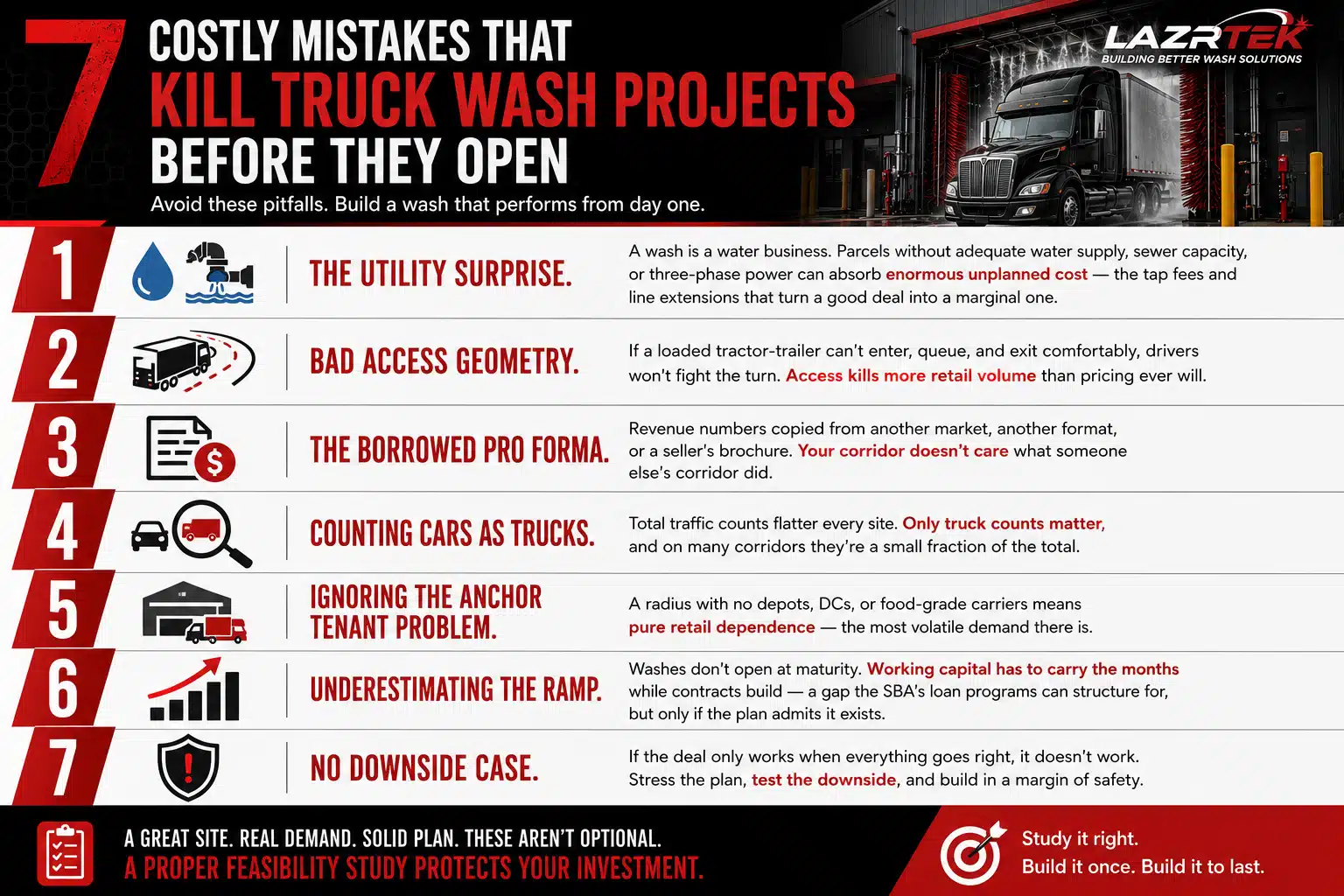
The seven
1. The utility surprise. A wash is a water business. Parcels without adequate water supply, sewer capacity, or three-phase power can absorb enormous unplanned cost — the tap fees and line extensions that turn a good deal into a marginal one.
2. Bad access geometry. If a loaded tractor-trailer can’t enter, queue, and exit comfortably, drivers won’t fight the turn. Access kills more retail volume than pricing ever will.
3. The borrowed pro forma. Revenue numbers copied from another market, another format, or a seller’s brochure. Your corridor doesn’t care what someone else’s corridor did.
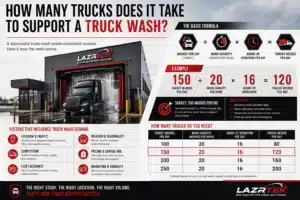
4. Counting cars as trucks. Total traffic counts flatter every site. Only truck counts matter, and on many corridors they’re a small fraction of the total.
5. Ignoring the anchor tenant problem. A radius with no depots, DCs, or food-grade carriers means pure retail dependence — the most volatile demand there is.
6. Underestimating the ramp. Washes don’t open at maturity. Working capital has to carry the months while contracts build — a gap the SBA\u2019s loan programs can structure for, but only if the plan admits it exists.
7. No downside case. If the deal only works when everything goes right, it doesn’t work.
The cheap insurance
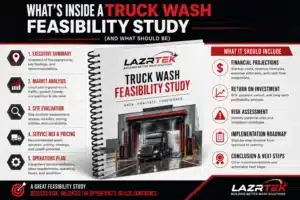
Every one of these is a line item in a proper truck wash feasibility study — which is why the study costs a fraction of a percent of the project and prevents the majority of its failure modes. If a study has ever told you something you didn’t want to hear, it was doing its job. The projects that clear an honest study are the ones you’ll find in our case studies.