Nothing sells a wash’s skill like a polished tanker leaving the bay — and nothing generates a damage claim faster than the wrong acid on that same tanker. Aluminum brightening is high-reward, high-consequence chemistry, and the difference is control.
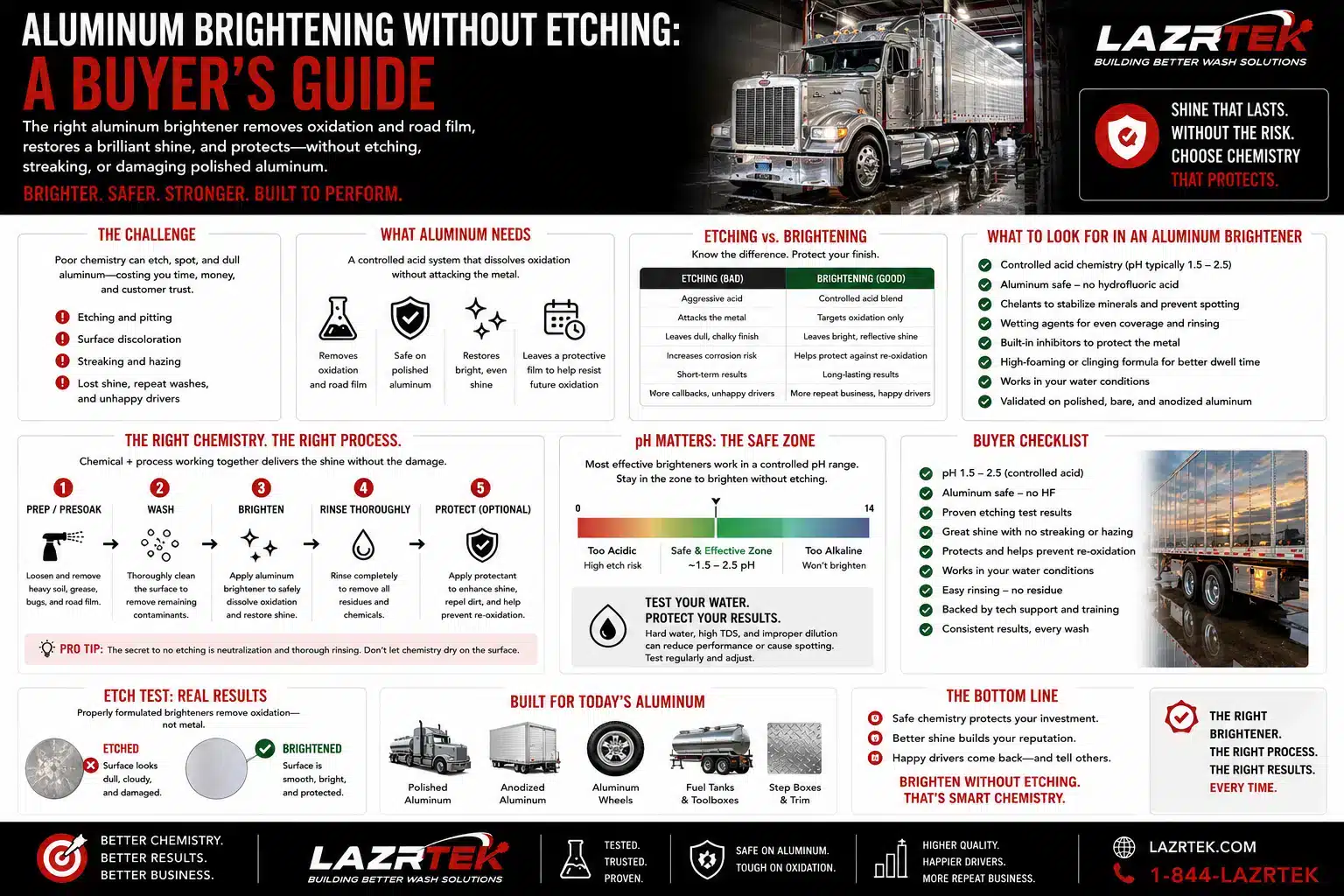
What brightening actually is
Oxidation dulls aluminum: a gray, chalky layer forms on tanks, wheels, and polished trailers. A brightener chemically removes that oxide layer to expose bright metal. The catch: the same chemistry that removes oxide will, uncontrolled, keep going — etching, streaking, and permanently frosting the surface it was meant to restore.
Controlled vs. crude
Crude brighteners rely on aggressive acid concentrations that work fast and forgive nothing — wrong dilution, extra dwell, or a hot panel and the finish is ruined. A controlled formulation like LZR-112 Controlled Aluminum Brightener is engineered for a wider safe window: effective oxide removal with dilution, dwell, and rinse tolerances an operator can actually hold in production.
Process protects the product
Even good chemistry needs discipline: correct dilution, application off direct sun, dwell by the clock, thorough rinse, and never letting product dry. Train it as a procedure, price it as the premium service it is — brightening tickets carry margins that reward doing it right.
Put it in the program
Brightening belongs inside a calibrated chemical program with dosing set for your water and equipment — the difference between a service that builds a reputation and one that funds a body shop.