Ask an operator their chemical cost per wash and you’ll usually get a shrug or a guess. That number is one of the most controllable in the entire business — and at most washes, nobody controls it.
How overdosing happens
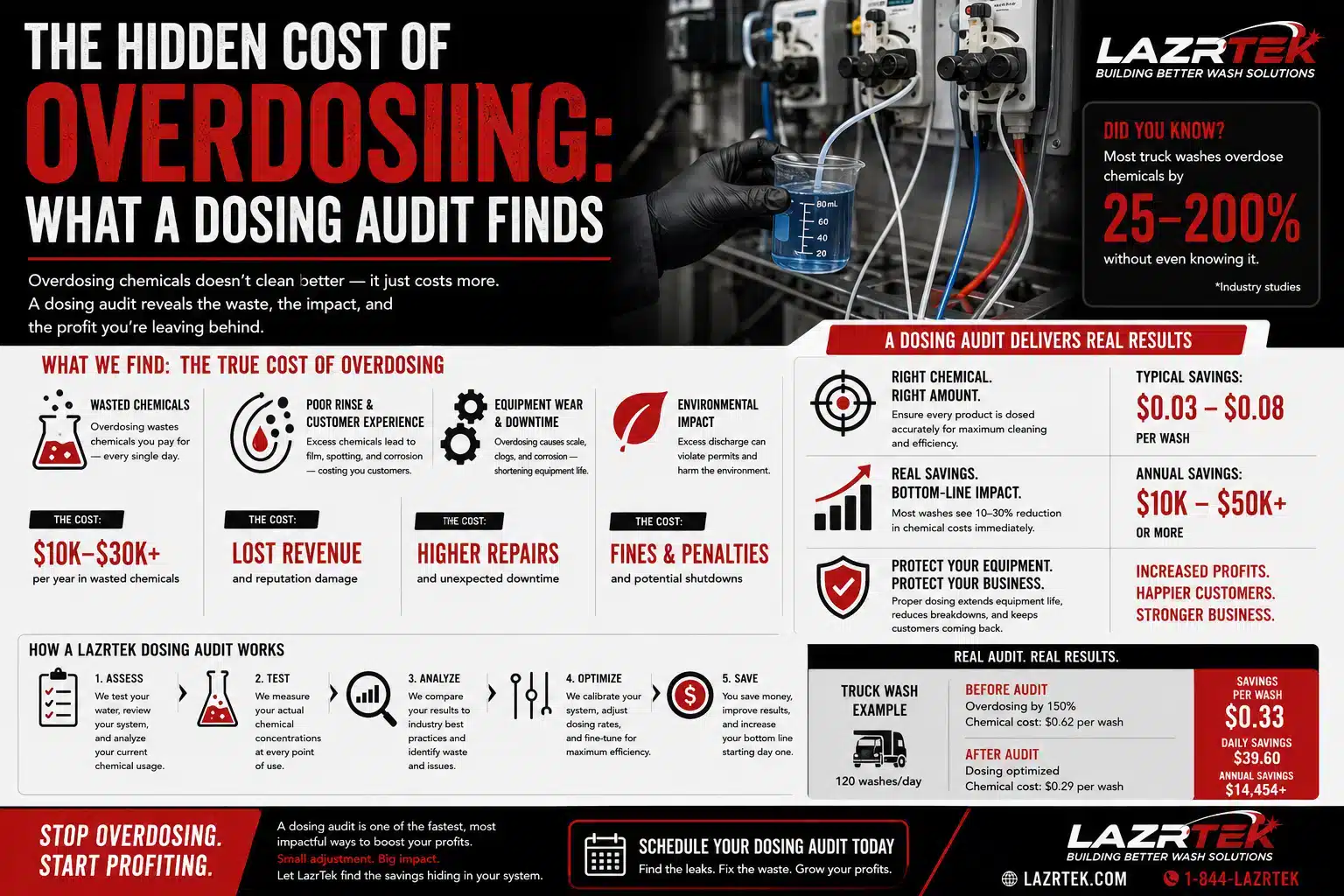
Nobody decides to overdose. It accrues: an injector wears and pulls rich, a tech “bumps it up” after a complaint and never bumps it back, a new drum’s concentration differs from the last. Each drift is invisible; together they routinely put actual dilution far richer than target — paying for chemistry the wash literally sends down the drain.
What the audit measures
A dosing audit is empirical, not theoretical: titrate what’s actually hitting the vehicle, compare against the target dilution for each product, inspect and recalibrate injectors, then verify with before/after foam coverage. The output is a corrected cost per wash and the calibration log to keep it corrected.
Why it compounds
Save even modest money per wash and multiply by your annual volume — the total is often a five-figure line item recovered without a single new customer. It’s also environmental discipline: right-dosing reduces the chemical load your reclaim and discharge systems carry, in line with the water-efficiency thinking the EPA promotes across commercial water use.
Getting it done
Dosing review is a core module of the LazrTek wash business audit, and the fix feeds directly into a chemical program that keeps the calibration from drifting again. The savings math from a real audit is on the chemical program page — dollars per wash, not percentages on a slide.