Every wash owner exits eventually — by plan or by surprise. The owners who exit well start years early, because the best succession options all require a business that runs without its founder standing in the bay.
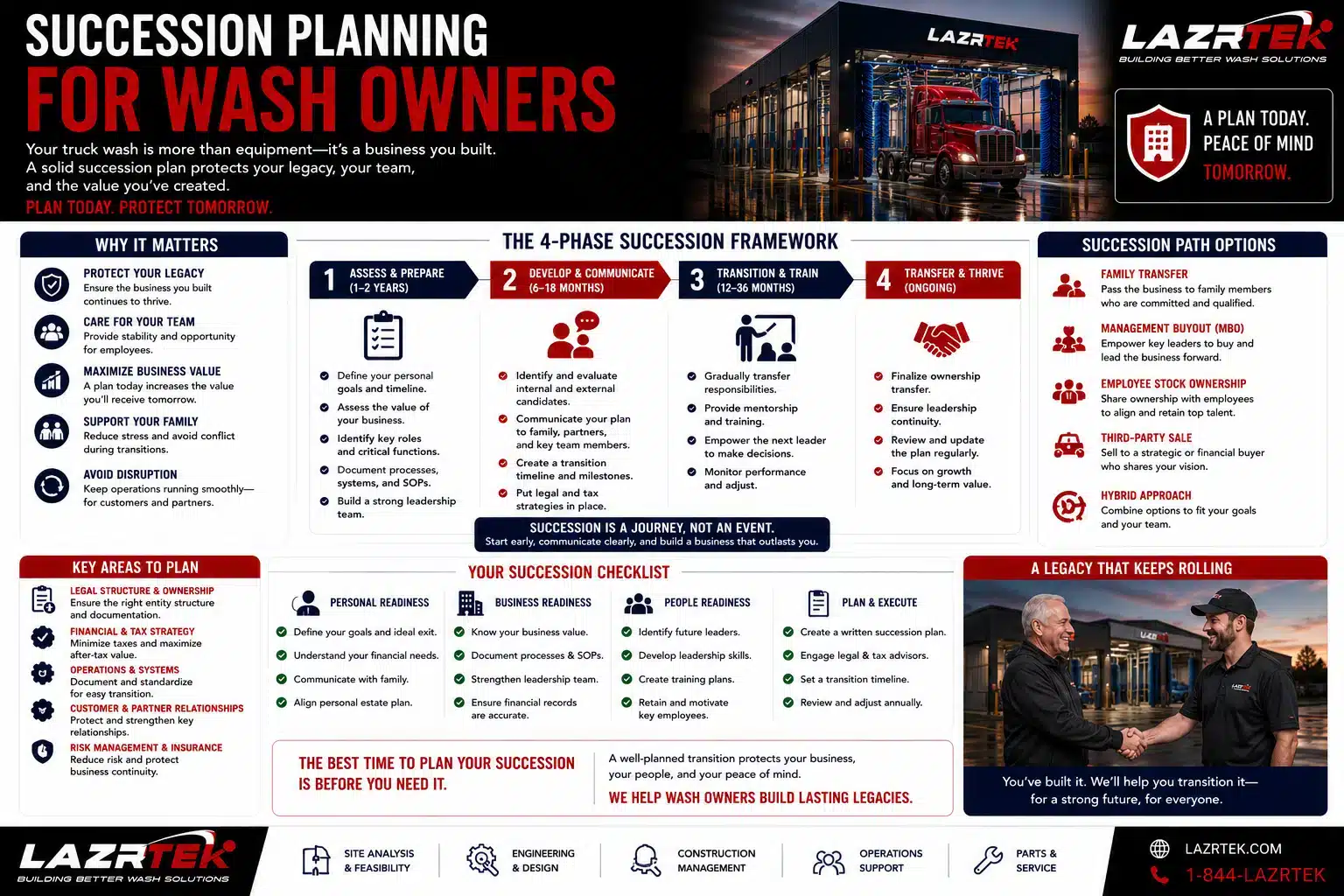
The three paths
Sell. Clean exit, full liquidity — at a price set by how transferable the business is. Buyers discount owner-dependence brutally: if the contracts, the vendor relationships, and the operational knowledge live in your head, they’re not buying a business, they’re buying your job.
Family transition. Emotionally appealing, operationally hard. It works when the successor has genuinely run the operation — not shadowed it — for long enough to own the mistakes. The SBA\u2019s guidance on business transitions is blunt about how often unprepared handoffs fail.
Managed passive ownership. The middle path: keep the asset and its cash flow, hand the operation to professional contract management. The wash keeps earning, the owner’s time is freed, and — critically — the business becomes documented and transferable, which makes every future option better, including an eventual sale at a stronger multiple.
Whichever path: document now
Contracts formalized, procedures written, KPIs tracked, maintenance logged. Documentation is succession’s raw material — and it happens to be the same discipline that makes the wash more profitable today. A business audit is a natural starting point: it inventories exactly what a successor, a buyer, or a manager would need to know.