In the logistics and transportation industry, a stationary wheel is a liability. Every minute a tractor-trailer spends sitting idle is a minute it isn’t generating revenue. Yet, maintaining a clean fleet is not optional; it is essential for brand reputation, regulatory compliance, and asset longevity. This creates a critical tension for fleet managers: How do you achieve a pristine, professional appearance without sacrificing valuable road time?
The traditional answer—manual washing—is no longer viable for high-volume operations. A manual wash crew, no matter how efficient, typically requires 45 to 90 minutes to thoroughly clean a standard tractor-trailer. For a fleet of 50 vehicles, washing them manually over a weekend is a logistical nightmare that incurs massive labor costs.
The solution lies in high-speed automation. But not all automated systems are created equal. When evaluating a capital expenditure for wash equipment, the most critical metric to scrutinize is throughput—specifically, how many trucks the system can process per hour. Understanding the mechanics of wash speed, the differences between system types, and the real-world ROI of high-volume washing is the key to streamlining your operations.
At LazrTek, we understand that whether you operate your own fleet or run a commercial truck wash business, throughput is the engine of your profitability.
The Economics of Wash Throughput
Before diving into the technical specifications, it is vital to understand why “trucks per hour” is a financial metric, not just an operational one.
If you manage a fleet of 100 trucks and your current wash method processes four trucks per hour, you are looking at 25 hours of continuous washing to cycle the entire fleet. If you upgrade to a system capable of 20 trucks per hour, that time drops to five hours.
That is a difference of 20 operational hours—time that can be used for maintenance inspections, loading, or simply getting drivers back on the road faster. Furthermore, high throughput eliminates the “queue bottleneck.” If five drivers arrive at the yard simultaneously at the end of a shift, a slow wash system creates a traffic jam that eats into driver off-duty time, damaging morale and retention. A high-speed system keeps the line moving, ensuring your drivers spend their time driving or resting, not waiting.
Technical Factors Influencing Wash Speed
Achieving high-volume throughput requires a perfect symphony of physics and chemistry. An automated system doesn’t just spray water; it engineers a cleaning environment. Several technical factors dictate exactly how fast a vehicle can move through the wash bay while still achieving a spot-free clean.
1. Chemical Dwell Time and Reaction
Speed relies on chemistry. In a touchless or hybrid wash environment, we utilize a “two-step” chemical process. First, a low-pH acid is applied to target inorganic matter like brake dust and oxidation. This is immediately followed by a high-pH alkaline detergent. When these two chemicals meet on the surface of the truck, they create a mild exothermic reaction that destabilizes the road film.
To wash a truck in under three minutes, this chemical reaction must be instantaneous. We achieve this through precision dosing systems that ensure the concentration is exact. If the chemical concentration is too weak, the truck must sit longer (dwell time) to get clean, killing your throughput. If it is dialed in correctly, the soil is loosened instantly, ready to be blasted away.
2. Water Pressure and Volume (Impingement)
Once the chemistry has loosened the soil, it must be removed. This is where “impingement”—the force of the water hitting the surface—comes into play. High throughput requires high-volume pumps.
A garden hose might offer 5 gallons per minute (GPM). A commercial fleet wash system often utilizes significantly higher GPM at pressures ranging from 300 to 1200 PSI. This massive volume of water allows the system to strip away heavy mud, grease, and salt in a single pass. The higher the effective cleaning power of the water jets, the faster the vehicle can move through the spray arch.
3. Automation and Sensors
Modern systems utilize advanced photo-eye sensors and loop detectors to profile the vehicle. These sensors tell the machine exactly when to start spraying and when to stop, and can even adjust the spray arches to the length of the vehicle. This eliminates the delay of a human operator manually starting the cycle, shaving precious seconds off every wash.
The Great Divide: Gantry vs. Drive-Through Systems
When researching automated truck wash systems, you will encounter two primary designs: the Gantry (Rollover) and the Drive-Through. The throughput capabilities of these two systems are vastly different, and choosing the wrong one for your volume is a costly mistake.
Gantry (Rollover) Systems
In a gantry system, the vehicle parks in a designated bay and remains stationary. The wash equipment—mounted on a set of rails—moves back and forth over the vehicle, performing multiple passes for soaking, washing, and rinsing.
- Throughput Profile: 4 to 6 trucks per hour.
- Best Use Case: Gantry systems are excellent for locations with limited space or lower daily volumes (under 20 trucks per day). They offer a very detailed clean because the machine can make multiple passes over stubborn areas.
- The Limitation: Because the machine must perform a pass, reverse, and potentially perform another pass, the cycle time is physically limited. Even the fastest gantries typically require 8 to 15 minutes per vehicle to complete a full cycle, including the time it takes for the driver to position the truck and exit the bay.
Drive-Through Systems
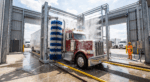
In a drive-through system, the wash equipment is stationary, and the vehicle moves. The truck drives through a series of arches (presoak, high-pressure rinse, wax, spot-free rinse) at a consistent slow speed.
- Throughput Profile: 15 to 20 trucks per hour (or more).
- Best Use Case: Medium to large fleets, commercial truck stops, and high-volume distribution centers.
- The Advantage: This is the gold standard for efficiency. Because the wash stages happen simultaneously (one part of the truck is being rinsed while the back is still being soaped), the process is continuous. As soon as one truck clears the first arch, the next truck can enter.
Breaking Down the 15-20 Trucks Per Hour Benchmark
How exactly do we achieve a rate of one truck every 3 to 4 minutes? It is achieved through a “frictionless” or “hybrid” drive-through configuration designed for continuous flow.
Here is what a typical high-speed cycle looks like in a drive-through setup:
- Entry (0:00 – 0:30): The driver approaches the bay. An automated traffic light signals them to enter. As the nose of the truck breaks the first sensor beam, the undercarriage wash and side blasters activate instantly to remove heavy chassis mud.
- Chemical Application (0:30 – 1:00): The truck proceeds through the presoak arch. The two-step chemical is applied. Because the truck is moving at a slow crawl (approx. 1 ft per second), the chemistry has just enough time to react before the truck reaches the high-pressure rinse arch.
- High-Pressure/Brush Cleaning (1:00 – 2:30): The truck moves through the cleaning stage. In a touchless system, rotating spinners blast the surface. In a brush system, sensing brushes gently contact the vehicle. This is the longest phase, dictated by the length of the tractor-trailer (typically 70+ feet).
- Rinse and Wax (2:30 – 3:00): The vehicle passes through the final rinse arch, which utilizes reverse osmosis (spot-free) water and a drying agent/wax.
- Exit (3:00 – 3:30): The truck exits the bay.
In this scenario, the actual washing process takes about three minutes. If you factor in a 60-second buffer for the driver to pull away and the next driver to approach, you are comfortably processing 15 vehicles per hour. With a trained fleet of drivers who maintain tight spacing, pushing that number to 20 trucks per hour is entirely achievable.
Variables That Impact Throughput
While 20 trucks per hour is the design capability of top-tier drive-through systems, real-world variables can influence these numbers. It is important to be realistic about your specific operational conditions.
Vehicle Size and Configuration
A standard 53-foot tractor-trailer is the baseline. However, if your fleet consists mostly of 26-foot box trucks or delivery vans, your throughput will skyrocket, potentially exceeding 30 vehicles per hour due to the shorter length. Conversely, Long Combination Vehicles (LCVs) or doubles will naturally take longer to pass through the optical sensors and spray arches.
Soil Loading
Throughput is inversely related to soil level. A fleet that operates strictly on paved highways will wash much faster than a fleet of oil field haulers or logging trucks covered in heavy clay and mud.
For extreme soil conditions, the drive-through system may require the driver to move slower (e.g., 0.5 ft per second) to allow the high-pressure jets more time to strip the mud. Some systems feature a “Heavy Soil” mode which instructs the driver to pause or move slower, which might reduce throughput to 8-10 trucks per hour—still significantly faster than manual washing.
The Human Element
The machine is ready to wash 24/7. The variable is often the driver. Throughput depends on drivers paying attention to the traffic signals and moving through the bay at the correct speed. We often recommend a brief training session for drivers on how to utilize the automated wash bay to maximize efficiency.
ROI: The Cost of Speed vs. The Cost of Waiting
When fleet managers look at the price tag of a high-volume drive-through system compared to a slower gantry unit, there is sometimes hesitation. However, the Return on Investment (ROI) calculation must include the cost of labor and downtime.
Let’s look at the math. If you are washing 100 trucks a week:
- Manual Wash: 100 trucks x 60 minutes = 100 labor hours per week.
- Gantry System: 100 trucks x 15 minutes = 25 operational hours per week.
- LazrTek Drive-Through: 100 trucks x 4 minutes = 6.6 operational hours per week.
The drive-through system saves nearly 19 hours of operational time per week compared to the gantry, and 93 hours compared to manual washing. Over a year, that is thousands of hours of regained productivity.
Furthermore, automated systems offer significant savings on water and chemicals. Our eco-friendly water reclamation systems allow you to recycle a vast majority of the water used, meaning high volume doesn’t equate to high utility bills. You can wash more trucks using less fresh water than a manual crew with a pressure washer.
Conclusion: Choosing the Right Velocity for Your Fleet
So, how many trucks can an automated system wash per hour? The answer depends on the technology you choose. A gantry system will reliably deliver 4-6 washes per hour, serving smaller fleets well. But for medium to large operators, a drive-through system is the undisputed king of efficiency, delivering 15-20 sparkling clean trucks every single hour.
In an industry where margins are tight and time is your most valuable commodity, upgrading to a high-throughput automated wash system is not just an expense—it is a strategic advantage. It protects your brand, preserves your equipment, and keeps your fleet doing what it was meant to do: moving freight.
At LazrTek, we specialize in advanced, custom-built wash solutions tailored to your specific volume needs. Whether you need a compact system for a small depot or a high-speed tunnel for a major distribution hub, we have the engineering expertise to maximize your uptime.
Ready to stop wasting time in the wash bay? Contact LazrTek today for a customized site analysis and ROI projection.